
Excavation cost in Los Angeles depends on what the contractor is pricing: digging alone, or the complete job through loading, hauling, disposal and final site preparation. To compare estimates, give each contractor the same dimensions, plans and access information, then check every inclusion and exclusion. A price per cubic yard is useful only when both the quantity and the work covered by that price are clear.
This 2026 guide to excavation estimates helps homeowners, builders and property managers compare quotes for foundations, backyard projects, pools and utility trenches. The worked examples below use invented numbers to explain the comparison; they are not BSLA prices or Los Angeles market averages. Request a site-specific estimate before setting your construction budget.
How much do excavation services cost in 2026?
Use published prices as scope examples, then obtain a written estimate for your residential project. One Southern California contractor’s October 2026 price guide lists excavation and clean-soil export at $65–$80 per cubic yard measured in place, including digging, loading, hauling and clean-dirt disposal, with a $3,500 job minimum. Its listed exclusions include permits, government fees, testing and engineering; shoring is extra unless listed.
Those are that provider’s published budget figures, not BSLA rates, a national average or a price promise for your excavation job. They illustrate why a rate needs its inclusions and minimum charge beside it. For a hypothetical 24-yard quantity at those published unit prices, the minimum alone would exceed the unit-price subtotal; other exclusions could add more.
What does an excavation cost calculator miss?
An online cost calculator can organize dimensions and unit prices. Its pricing data may not reflect your access, soil type or disposal arrangements. When reading cost guides, check the date, location, measurement basis and included work. Use current, site-specific cost data to assess the quote rather than treating a calculator result as a bid.
Which cost factors affect excavation pricing in Los Angeles?
The main cost factors are excavation quantity, depth, soil conditions, equipment access and the destination for the excavated material. Two properties with the same backyard area can need very different amounts of machine time and trucking. Start with the proposed work, rather than the lot’s square footage.
Project size, depth and the finished condition
A shallow patio cut, a footing trench and a swimming pool excavation are different scopes. The contractor needs the excavation footprint, required depths and target elevations. Plans may also require working room, approved slopes or over-excavation beyond the structure’s outline. Those additional quantities belong in the estimate.
Define the handoff: an open excavation at the required elevation, a rough-graded site, or a compacted surface ready for the next trade. Excavating and grading are related services, but a digging allowance does not automatically cover fine grading or imported base material. Ask whether grading cost is separate. Our rough grading versus finish grading guide explains those stages.
Land clearing and demolition can also precede land excavation. Removing vegetation, breaking an existing slab and digging below it are separate activities with different waste streams. General contractors coordinating new construction should identify which trade handles each activity so the same construction work is neither omitted nor counted twice.
Soil conditions, rock and buried obstructions
Loose soil, hard material and buried concrete need different handling. Old footings, roots or undocumented fill can change excavation methods and disposal arrangements. Give bidders any available soils report and site history. Ask what ground conditions the base price assumes and how a different condition will be documented.
If rock breaking is excluded, request a separate rate or a written pricing process. Clarify whether that rate covers the attachment, operator, additional time and removal of the broken material. The same approach applies to buried debris: identify the allowance before work starts.
Access for equipment and trucks
A machine must reach the work area, turn and operate safely. Measure the narrowest opening and describe steps, steep driveways, low overhead clearance and existing hardscape. A gate measurement alone does not establish access; the approach, turning space and surface conditions matter too.
When a truck cannot approach the excavation, soil may need to be moved to a separate loading point. Smaller equipment or repeated handling can increase labor costs even when the excavation volume stays the same. Ask the contractor to identify the planned loading area, haul path and protection for surfaces that equipment will cross.
The type of equipment affects productivity as well as access. A mini excavator or backhoe may suit one work area, while a larger earth-moving operation may use a bulldozer, loaders and dump trucks. Ask which excavation equipment and skilled operators are included. Heavy machinery must suit the residential site’s working space; simply choosing a larger machine does not establish a lower total cost.
What should an excavation quote include?
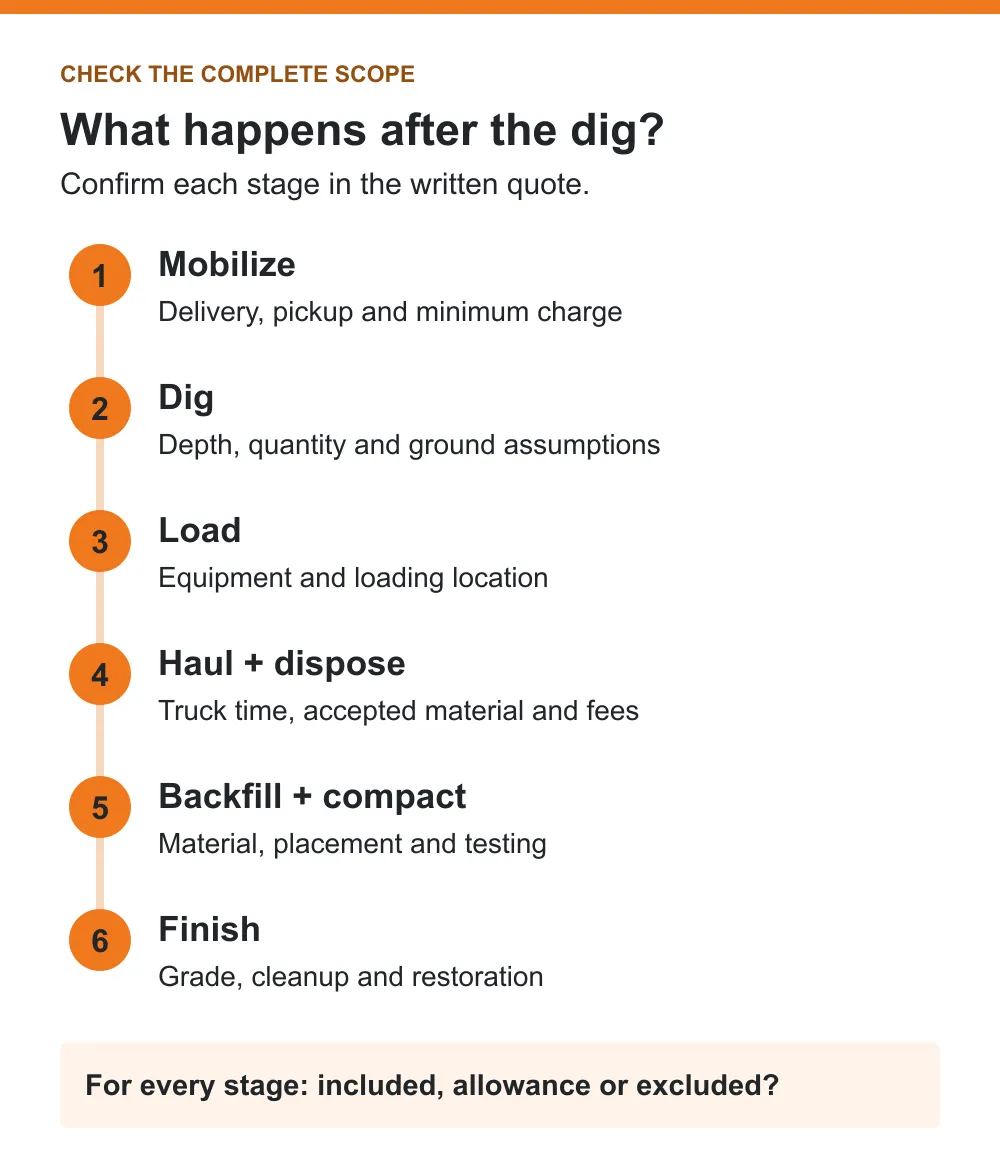
A useful estimate states the work, the quantity, the pricing basis and the completion point. Use the same checklist for every contractor so a missing item is visible before you compare totals.
| Item | What to confirm in writing |
|---|---|
| Scope and plans | Work area, depth, elevations, drawing revision and assumptions. |
| Mobilization | Equipment delivery, pickup, setup and any minimum charge. |
| Excavation | Machine and operator, expected material, working room and quantity basis. |
| Loading and hauling | Whether export is included, estimated loads, trucking time and waiting charges. |
| Disposal | Material accepted by the receiving facility, disposal charges and documentation. |
| Access and protection | Loading location, surface protection and any separately priced access work. |
| Backfill and compaction | Material source, placement, required testing and responsibility for reports. |
| Plans, permits and inspections | Who arranges each item, pays the fees and coordinates inspection hold points. |
| Cleanup and restoration | Final grade, leftover material and repairs to paving, fences or landscaping. |
| Changes and payment | Allowances, unit rates, written approval process, payment stages and quote validity. |
“Included” should mean the same thing on each bid. For example, “soil removal included” is incomplete if the quote does not say whether it covers loading, truck transport and disposal fees. Ask for a revised scope when an answer is unclear.
How do you calculate excavation volume and hauling quantity?
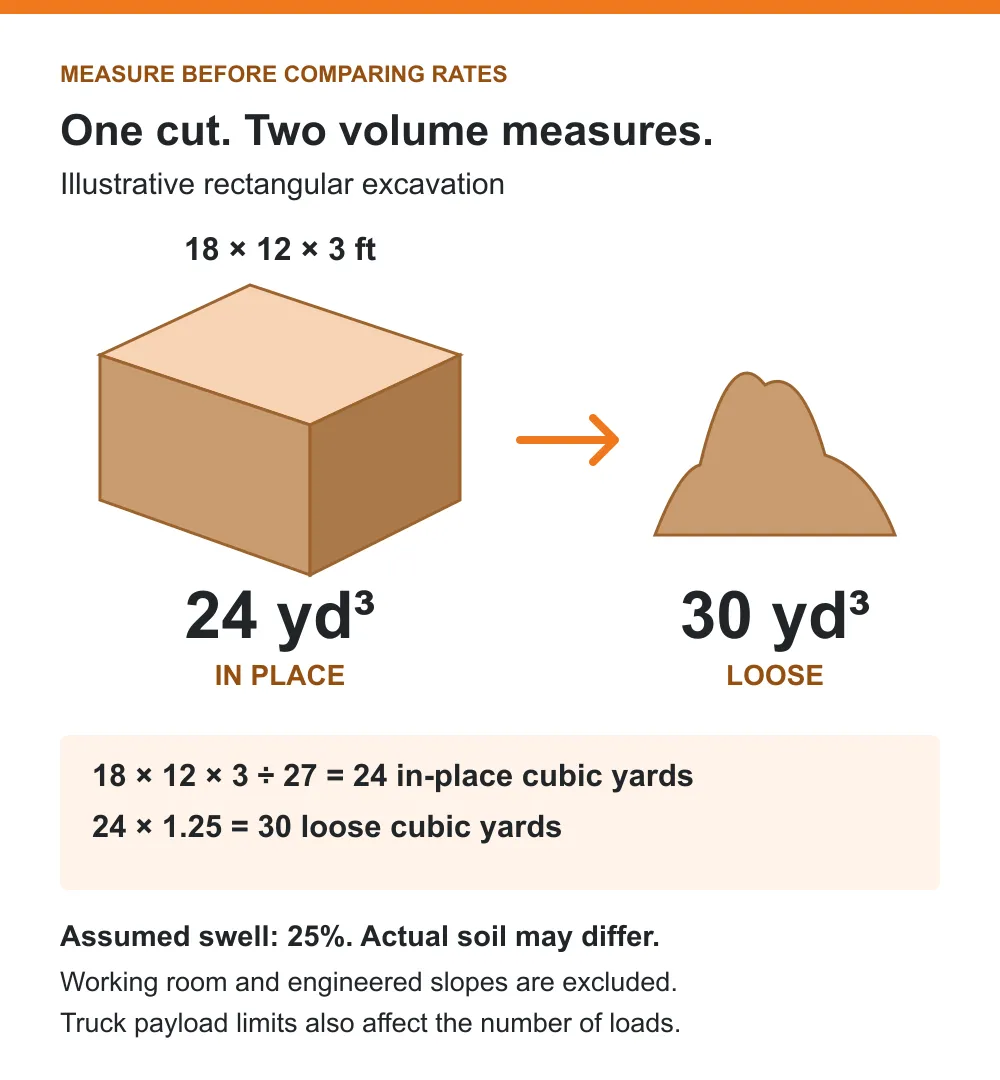
For a simple rectangular excavation, multiply length by width by depth in feet, then divide by 27 to convert cubic feet to cubic yards:
In-place cubic yards = length × width × depth ÷ 27.
For example, a hypothetical cut measuring 18 feet long, 12 feet wide and 3 feet deep contains 648 cubic feet, or 24 in-place cubic yards. This measures the rectangular cut only. It excludes any additional excavation needed for working room, slopes or the project’s engineered design.
Once dug, soil can occupy more space because it loosens. That expanded material is measured as loose volume. For illustration only, assume a 25% increase: 24 × 1.25 = 30 loose cubic yards. The actual swell factor depends on the material; 25% is an example assumption, not a standard allowance for your property.
Ask whether a per-cubic-yard quote uses the in-place measurement or the loose export measurement. If the rate already includes trucking for the agreed in-place quantity, adding a separate swell charge without checking the scope could count the same work twice.
Why truckloads are not a fixed number of cubic yards
Truck capacity is constrained by both usable body volume and allowable payload. Wet or dense soil can reach the weight limit before the truck body is full. Ask what load size the estimate assumes and how actual loads will be recorded. A truck’s advertised capacity alone does not establish the number of legal loads your project needs.
Also establish how much suitable soil will remain on site for approved backfill. On a cut and fill project, the planned balance affects dirt removal and imported material. Exporting material that later has to be replaced can add hauling and purchase costs. Reuse must fit the plans and material requirements; do not assume all excavated soil is suitable structural fill.
How can you compare excavation companies’ cost estimates?
Compare total costs for the same completed scope. The following is a hypothetical arithmetic example, with invented prices and no connection to a real property, contractor quote or local rate.
| Item | Quote A | Quote B |
|---|---|---|
| Quoted base | $5,200 | $7,100 |
| Hauling and disposal | $1,800 additional | Included |
| Specified backfill work | $700 additional | Included |
| Total for matched scope | $7,700 | $7,100 |
Quote A starts $1,900 lower but becomes $600 higher after those two omissions are included. This does not make Quote B automatically preferable. Check that quantities, exclusions, material assumptions, inspection responsibilities and completion standards also match.
Hourly, unit-price or lump-sum pricing?
Hourly pricing needs a definition of chargeable time: delivery, setup, digging, truck waiting and cleanup may be handled differently. Confirm which equipment and labor are included and ask how time records will be shared.
Local labor rates in a contractor’s proposal cover a different basis from an employee wage figure: the quoted service may include crew costs, insurance, overhead and equipment. Compare the labor cost alongside its inclusions, and verify the hourly equipment charge before adding it to a crew rate.
Unit pricing needs a measurable quantity and a defined activity. A rate per linear foot of trench must specify width and depth. A rate per cubic yard must define measurement and whether loading, export and disposal are included.
A lump-sum bid needs a clear scope and change conditions. It can simplify comparison when plans and quantities are established, but excluded rock, unsuitable soil or changed dimensions can still require additional work. Ask bidders to price optional work separately where practical.
Which permit and safety responsibilities affect the estimate?
Confirm the municipality or other permitting authority for the property. Permit requirements vary across cities and counties; City of Los Angeles rules do not automatically describe every city in Los Angeles County. The LADBS grading permit guidance identifies work requiring grading review, including substantial site preparation and specified hillside excavations. Ask who supplies plans, obtains approvals and pays fees, and whether these services are included in the excavation price.
Hillside projects may also need import-export route review. Ask the project team to confirm applicable haul-route conditions and any restrictions on loading or truck movements before the schedule is finalized. Our hillside excavation guide provides additional project context; use the current agency requirements for your approval.
Utility coordination and protective measures also belong in the scope. California’s excavation requirements address locating underground installations before excavation. Its protective-system requirements cover cave-in protection, with specified exceptions. Ask the contractor how these obligations are covered in the proposed work and price. Read our 811 preparation checklist when organizing the project.
Soil testing, survey work and engineering may be provided by other professionals. Identify who schedules them and which stages require approval before backfill or the next trade proceeds. Do not treat a low estimate as complete until these responsibilities are assigned.
How do you reduce unexpected excavation charges?
Reduce uncertainty before mobilization. Share the current plans, the soils report if available, photos of the complete access route and known information about buried structures. Ask the estimator to walk the site where access or ground conditions cannot be established from documents.
Before authorizing work, agree on a written process for changes. The record should identify the condition found, the proposed additional scope, the price or rate basis and any schedule effect. Request photos, measurements or other supporting records appropriate to the change. Keep urgent site-protection decisions with the responsible professionals.
Review allowances for rock, unsuitable material, extra export and truck waiting. An allowance is an assumption within the estimate, not proof the final quantity is known. Ask how unused allowances and overruns are reconciled. Set a project-specific reserve with your contractor and design team instead of relying on a universal contingency percentage.
For projects involving approvals or a new backyard building, review our grading and excavation permit guide and ADU excavation guide when preparing the information for your excavation estimate.
Browse more articles in Planning, Costs & Permits.
Request a site-specific excavation estimate in Los Angeles
For an estimate from BSLA, prepare the project address or ZIP code, the intended work, approximate dimensions, available plans and photos showing the access route. Mention whether soil will stay on site or need hauling away, and whether grading, backfill, compaction or hardscape restoration is part of the request.
Call 323-403-0924 or use the website’s quote form to discuss your project. The useful comparison is a written estimate tied to your site’s quantities, access and required finish.