
In construction, site preparation sets the stage for your project’s success. It involves thorough site assessments, clearing with precision, and careful grading, ensuring soil is analyzed for foundation integrity. You’ll coordinate infrastructure upgrades, aligning utilities for efficiency and safety. Maintaining ecological awareness through environmental safeguards is essential, as is implementing robust safety measures. By managing these elements carefully, you’ll mitigate risks, enhance project execution, and pave the way for development advancements yet to come.

Before you break ground on any construction project, conducting an extensive site evaluation is vital to success. You must first consider site stability by reviewing soil stability, drainage patterns, and geological hazards. This guarantees your foundation is viable and robust.
An ecological evaluation is important, too, as it helps identify ecological buffers like riparian zones and native vegetation. Maintaining these natural elements supports environmental balance and sustainability.
Additionally, analyzing climate conditions and hydrological data informs your material selection and structural resilience. You should also map invasive species and protected plant communities, establishing conservation strategies that align with your project goals. Furthermore, a comprehensive site clearing process ensures that unwanted materials are effectively removed, creating a clean slate for construction.
Conducting a thorough site evaluation not only minimizes risks but also sets the stage for a successful construction process, balancing nature and development effectively.
When you’re starting on a construction project, mastering effective clearing and grading techniques is vital for laying a solid foundation. You need to decide between mechanical vs manual methods.
Mechanical tools like bulldozers and excavators handle large-scale clearing efficiently, reshaping terrain and guaranteeing precision with GPS-guided systems. Meanwhile, manual techniques using hand tools are perfect for smaller, sensitive areas, allowing you to preserve desirable vegetation.
Effective debris management is important throughout this process. Consider on-site chipping to create reusable mulch for soil stabilization, or follow controlled burning protocols where permitted.
Always separate recyclable materials during debris collection and guarantee proper disposal, adhering to environmental regulations. These strategies help maintain a clean site, preparing it well for the next construction phases. Additionally, utilizing bobcat services can enhance the efficiency and safety of your site preparation efforts.
Understanding the intricacies of soil assessment and foundation planning is essential to any successful construction project. You’ll need to start with soil sampling, distinguishing between disturbed and undisturbed samples.
Depth profiling, done through boreholes and trenches, gives a vertical view of soil layers. Moisture content tests are fundamental for evaluating compaction readiness, while field penetration tests (like SPT or CPT) quickly offer strength profiles.
When it comes to foundation design, calculate the bearing capacity using shear strength and density data. Decide between deep or shallow foundations based on soil compressibility.
Liquefaction assessments, which analyze grain size and shear resistance, are critical. Testing essential soil properties helps identify risks and informs stabilization techniques like lime mixing or vibro-compaction.
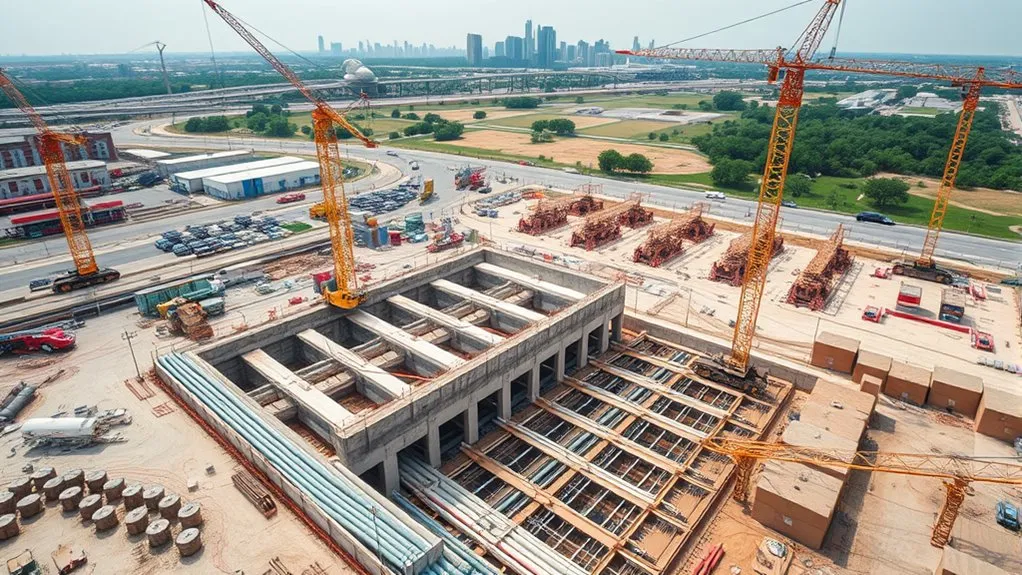
With a solid foundation in soil assessment and planning, it’s time to focus on the next essential phase: strategic utilities and infrastructure development.
To guarantee success, start with utility coordination to align upgrades with energy efficiencies and regulatory compliance. Evaluate your current infrastructure for optimization opportunities, considering feasibility studies to map existing utilities and identify potential risks.
It’s vital to categorize utilities like electricity, gas, and water separately, guaranteeing each receives the appropriate design and safety protocols. By implementing independent oversight, you streamline management and mitigate risks through effective planning.
Full project management consolidates efforts, addressing disconnections and new installations without delay. With strategic alignment, your utility projects will support core business needs, enhancing both production capacity and employee safety.
To guarantee a construction project aligns with environmental safeguards and compliance, it’s crucial to prioritize responsible site selection and development practices. Start by avoiding ecologically sensitive areas such as floodplains, wetlands, and habitats for endangered species.
Preserving natural vegetation helps maintain biodiversity and reduces soil erosion. Conduct environmental impact assessments (EIAs) to identify potential disruptions and develop mitigation plans. Embrace eco-friendly practices by sourcing local materials, reducing transportation emissions, and supporting regional economies.
Maintaining biodiversity and reducing soil erosion through eco-friendly practices and local material sourcing.
Regulatory frameworks require collaboration with environmental experts to protect high-value ecological zones.
Implement erosion control measures like silt fences and sediment basins to prevent runoff pollution. Use erosion control blankets to stabilize slopes and protect nearby water bodies with buffer zones.
Regularly monitor these systems to guarantee ongoing effectiveness.
When launching a construction project, implementing robust safety and compliance measures is vital to protect workers and guarantee a smooth workflow.
Start by conducting regular site safety inspections and reporting practices to spot hazards early. Use a risk assessment matrix to prioritize and address risks, making immediate corrections when needed.
Pre-construction safety planning is essential; develop site-specific plans and train crews on relevant project risks, like high-risk machinery and confined spaces.
Compliance audits help verify adherence to OSHA standards, focusing on fall protection and hazard communication. Regularly evaluate PPE usage and scaffold stability during walkthroughs.
Safety training prepares your team for project-specific challenges, fostering a culture of safety. Document findings in thorough reports, including incident reports and site photos.
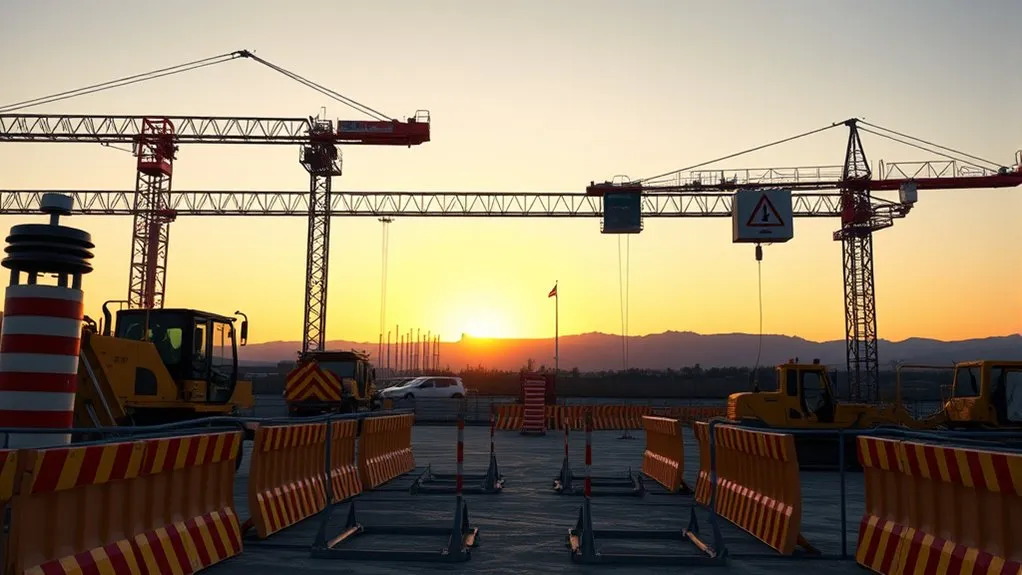
In launching a construction project, it’s essential to prioritize emergency preparedness and risk management to safeguard both workers and the project itself.
Start by conducting thorough hazard assessments to identify site-specific risks like fires and chemical spills. Involve your team in this process—frontline insights can improve hazard communication and ownership.
Establish emergency response teams with clear roles and chains of command. Regular emergency drills guarantee everyone knows evacuation routes and equipment shutdown procedures.
Develop effective communication protocols, including accessible emergency contact lists and alarm systems to quickly alert everyone on site.
Finally, schedule regular drills and training sessions, simulating worst-case scenarios to test your plans. This proactive approach guarantees a unified, efficient response in emergencies.
To break the preparation scope into clear stages, read our construction site clearing overview and rough grading versus finish grading guide and identify the completion point expected from each trade.
Browse more articles in Excavation & Site Preparation.
In understanding site preparation, you’ve journeyed through essential steps like thorough site assessments and effective clearing techniques, akin to setting the stage for a grand theatrical performance. By focusing on soil assessment, infrastructure, and safety measures, you’re ensuring a solid foundation for any construction project. Remember, environmental compliance isn’t just a box to tick—it’s vital for sustainable development. With these insights, you’re well-equipped to tackle the complexities of construction with precision and confidence.
Skip to content