
Sewer-line trenching needs a verified connection point, usable pipe elevations and a clear permit and inspection plan before excavation starts. Identify the jurisdiction and the boundary between private-property work and work in the public right-of-way. Those distinctions affect who may obtain the permit, who performs the connection and which inspections apply.
This guide focuses on planning excavation and site preparation. A plumber, designer, utility or City-approved sewer contractor may be needed for separate portions of the project.
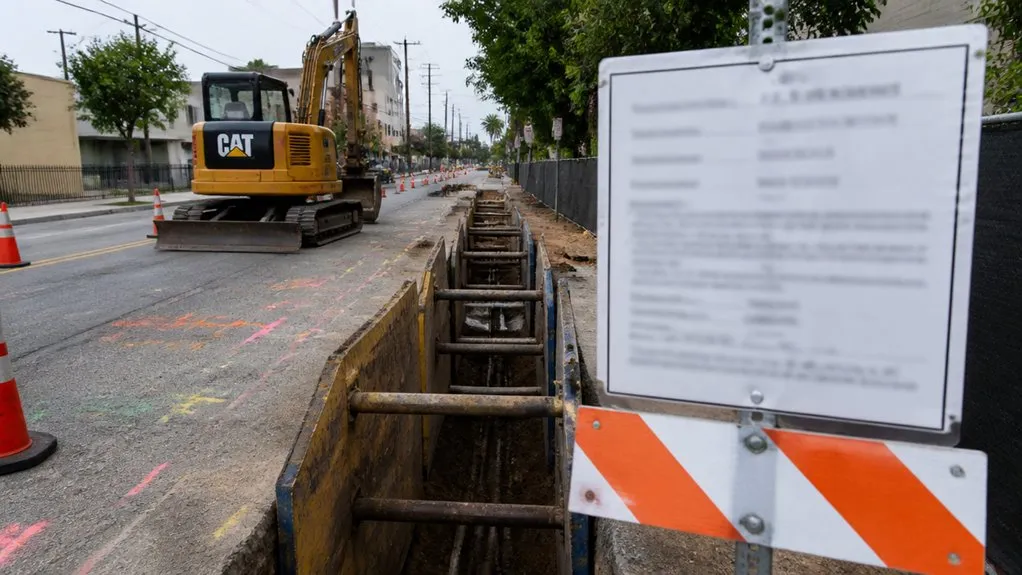
For City of Los Angeles work, the Los Angeles S-Permit purpose and contractor requirements covers matters such as a new house connection, connecting to an existing house connection at the property line and repairing a damaged house connection.
The City’s distinction matters: work in the public right-of-way requires a City-approved Bonded Sewer Contractor to obtain the permit and perform that work, with Bureau of Contract Administration inspection. Some qualifying private-property connections may be permitted to a plumber or contractor outside that approved list. Do not assume every private backyard sewer repair has the same contractor requirement as a street connection.
Confirm the actual scope with the Bureau of Engineering and relevant building authority. Los Angeles County and other cities have their own procedures. Establish who is approved for each portion; an excavation proposal alone does not establish Bonded Sewer Contractor status.
Have the responsible plumber or designer verify the existing connection, pipe size, condition and invert elevations—the inside-bottom elevations used to establish the pipe profile. A cleanout or old drawing is a useful starting point, not proof of an available connection at a workable depth.
Lay out the proposed alignment and required grade before estimating excavation. Resolve crossings, foundations, trees and access limitations early. If a route crosses another property, address the required legal access and recorded easement before work; permission to enter does not by itself establish a permanent sewer easement. The Los Angeles S-Permit conditions, including easements and pipe bursting explains the City’s easement requirements.
Before the locate request, delineate the proposed excavation in white. In Los Angeles, use DigAlert through 811. Give at least two working days’ notice, excluding the notification date; weekends and applicable holidays do not count. The excavator must check the ticket’s legal start time, all required positive responses and the field conditions before digging. Missing or inconsistent marks require resolution with DigAlert and the affected operator.
California excavation law, including notice, tolerance zones and damage reporting explains the excavation notice process. Nonpressurized sewer and drain lines are excluded from its definition of subsurface installation, so do not expect 811 to map every gravity sewer lateral. Arrange the separate sewer investigation and private locating appropriate to the project.
Have conflicting utilities positively located before powered excavation near them. Plan access for the crew, inspector and pipe installer, along with spoil removal and barriers. Do not stage materials where they obstruct a required access route.
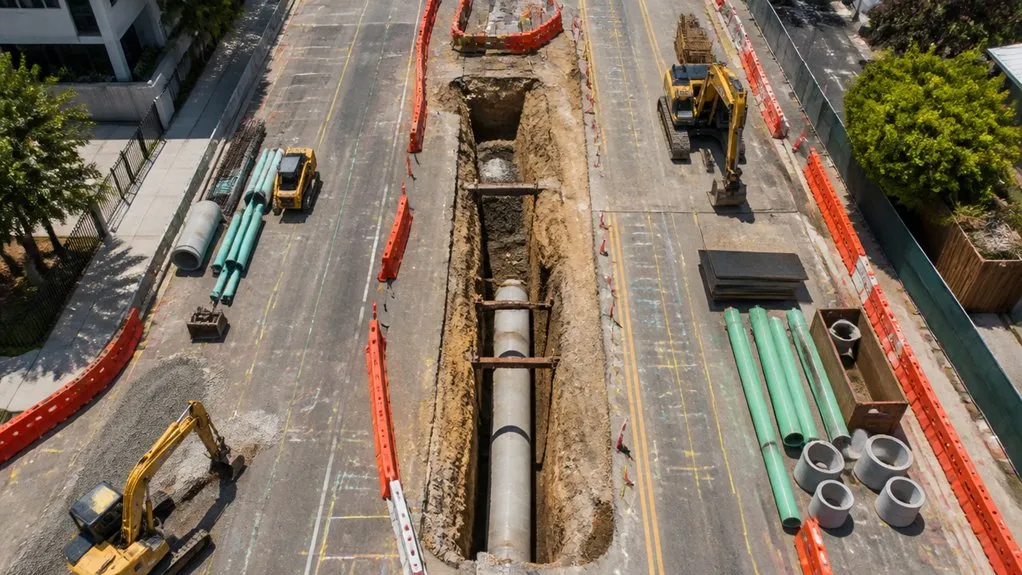
Ask the responsible designer and authority to confirm required separation from water, gas, electrical facilities and structures for this installation. City sewer-connection details and mainline standards are not interchangeable with every private building-sewer detail.
If the trench approaches a footing, retaining wall, pole or another facility, assess the support and loading conditions before excavation. A generic setback number does not establish that undermining is safe. Resolve an insufficient clearance with an approved route change or detail rather than improvising at the crossing.
The approved pipe profile, diameter, bedding, installation method and protective system determine the excavation. Obtain the section detail and working-space requirements before selecting equipment. Do not use one gutter-depth or maximum-width figure for every sewer project.
The contractor must evaluate the soil, water, nearby foundations, traffic and equipment loads before choosing the excavation method. Under Cal/OSHA protective-system requirements, Section 1541.1, employees need adequate cave-in protection unless the excavation is entirely in stable rock, or is less than 5 feet deep and a competent person finds no indication of a potential cave-in. Protection may therefore be needed below 5 feet.
Cal/OSHA excavation requirements, Section 1541 requires safe egress for trenches 4 feet or deeper, with no more than 25 feet of lateral travel for employees. Atmospheric testing applies before entry into excavations deeper than 4 feet where an oxygen deficiency or hazardous atmosphere exists or can reasonably be expected. A competent person must inspect excavations before work, as needed during the shift and after rain or other events that increase hazards when employee exposure can reasonably be anticipated. Homeowners should stay outside the excavation.
Build the sequence with the permit holder and pipe installer: confirm locating and the approved connection; excavate and provide the specified protection; prepare bedding and install the pipe; complete required tests and open-work inspections; obtain release for cover; then backfill and restore.
Identify who books the inspections and what must remain visible. Private-property plumbing inspection and public right-of-way inspection may involve different authorities. Do not rely on another jurisdiction’s notice period or assume one final inspection covers every stage.
Specify backfill materials, compaction, testing and surface restoration for the actual location. Include temporary access and protection while awaiting the next work stage, and retain the approved route and inspection records.
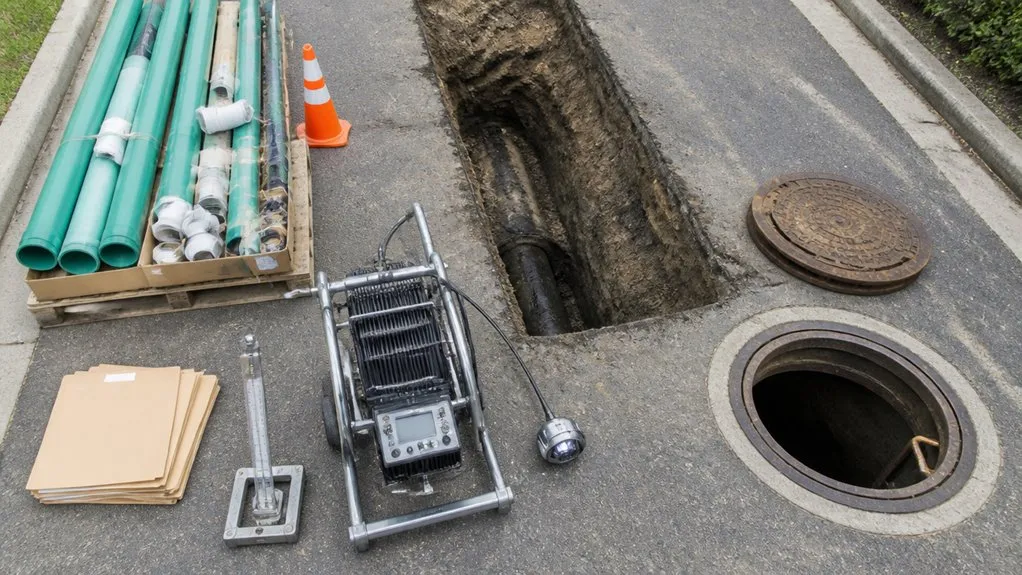
Camera inspection can help assess an existing sewer, but permit requirements depend on scope. The Los Angeles S-Permit conditions, including easements and pipe bursting specifically requires a Bonded Sewer Contractor and before-and-after CCTV for pipe bursting. That does not establish the same camera package for every private repair.
Use the Los Angeles S-Permit processing procedures to identify applicable investigation, connection and capacity-review steps. Ask the permit authority what records, tests and approvals this application needs. A camera survey or dye test does not itself grant permission to connect to the public sewer.
Obtain current permit charges and inspection instructions for the project rather than relying on a fixed fee or a single promised approval timeline.
Who obtains the street-work permit? For City of Los Angeles sewer work in the public right-of-way, coordinate the S-Permit and work with the City-approved Bonded Sewer Contractor and Bureau of Engineering. Verify any associated permits for the scope.
Is CCTV needed before and after every job? Follow the permit conditions and investigation needs of the actual method. Pipe bursting has an explicit City requirement; other work must be checked individually.
Can an adjacent property be used for access? Resolve construction access and any required recorded sewer easement with the owner and authority before work. Do not treat a convenient route as an approved one.
For sewer excavation and site preparation, call 323-403-0924 or request an estimate from BSLA. Provide the ZIP code, project type, approximate route length, access width, surface materials, permit status and intended schedule. Ask the team how to share plans and site photos after contact.
Request a written scope identifying excavation, hauling, backfill and surface restoration separately from design, utility work and licensed trade installation or testing. Our excavation service overview explains the site-work services to discuss with the team.
Alongside the sewer layout, review our trenching safety overview and 811 preparation checklist when coordinating access, utility information and the excavation sequence.
Browse more articles in Trenching & Utilities.
Accuracy review completed October 21, 2026. Confirm current project requirements with the responsible authority, utility and qualified trade before work.