
Backyard water line trenching in Los Angeles demands proper permitting and coordination, especially when work affects public streets or LADWP service. Contractors must plan pipe depth and maintain safe sewer separation, typically keeping water lines at least 10 feet from sewer lines unless approved. Before digging, they should use 8-1-1 utility marking and pre-mark excavation limits. Crossing utilities may require grouting and clearances. Costs often run $5–$12 per linear foot, so smart field steps and inspections help avoid rework—keep going to learn more.
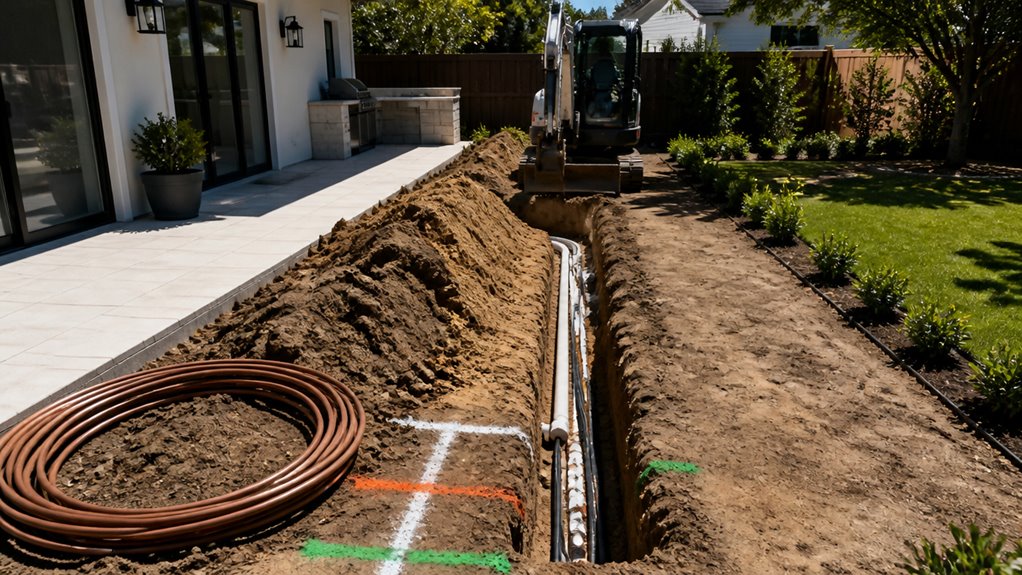
Guiding backyard water line trenching starts with permits, because where the trench runs determines which agency reviews the work. In Los Angeles, public-street trenching requires an application to the Bureau of Engineering, with specific permit types tied to excavation or encroachment in a public street or place. The application process typically begins with a plan in triplicate, showing excavation location and dimensions, and it may require extra drawing sets when the utility is longer than 20 feet. If the work affects a public main, the permitting path stays separate from any private-property digging exemption and still needs public-works review. For County house water-line connections, an excavation permit can be handled at the nearest permit office, with a special submission path for long runs. As part of proper planning, licensed professionals help ensure the work is performed safely and meets the required local criteria.
Selecting trench depth and planning sewer separation are two of the most important design choices for Los Angeles backyard water lines, because cover requirements and spacing rules set firm limits on where the pipe can physically be installed. County guidance commonly specifies 24 inches of cover for service pipelines on local streets, while nonhazardous lines may require 30 inches on local streets and 36 inches on master plan highways. The contractor must treat these as minimum cover values, then adjust the pipe invert for bedding and surface restoration. Sewer separation is a special constraint: waterlines generally must be at least 10 feet from a sewer line unless documented approval is obtained. Experienced excavating contractors also factor in minimum cover values during layout to avoid under-cover conditions. 1. Verify roadway class cover. 2. Confirm bedding thickness. 3. Maintain 10-foot sewer separation. 4. Use documented exceptions.
In Los Angeles, a backyard trenching project should start with an 8-1-1 ticket so utility operators can mark buried lines before digging begins. California rules require the notice be made at least 2 working days ahead. Before the locate crews arrive, the proposed excavation limits should be pre-marked in white so the markings clearly match the planned work zone. Then each color-coded utility mark can be checked against the site layout. After all operators respond and the clearances are verified, the trenching can proceed with greater safety and fewer surprises. Using licensed, insured, and bonded operators helps ensure the process is handled professionally and safely from start to finish.
Before any backyard trenching begins in Los Angeles, the site must be set up to verify that utility clearances are protected. Crews should white-mark the exact proposed trench route before utility locators arrive, using chalk, paint, stakes, or flags.
After marking, they should allow the required waiting time, since tickets must be issued at least 2 working days ahead, and online requests may need 3 days. Digging must start only after utility confirmation for every operator on the ticket, and after checking marks for completeness, accuracy, and legibility.
Workers should understand the tolerance zone, the facility width plus 24 inches on each side, where mechanical digging is unsafe. If marks are missing or unclear, re-marks should be requested before digging, supporting clearance verification.
Crossing a water line with other utilities demands careful spacing, because clearance rules protect both safety and long-term system performance.
In Los Angeles, engineers check crossing clearances before digging, often requiring 6 inches minimum separation when utilities cross, and larger spacing when they run parallel.
County guidance may call for 2 feet from other pipelines and 3 feet from sewer lines, while waterlines typically need more distance from sewers unless permission is granted.
For any cased bored crossing, grouting requirements matter: the gap between borehole and casing must be cement-grouted, and the annular space must receive cement slurry for void filling and seepage control.
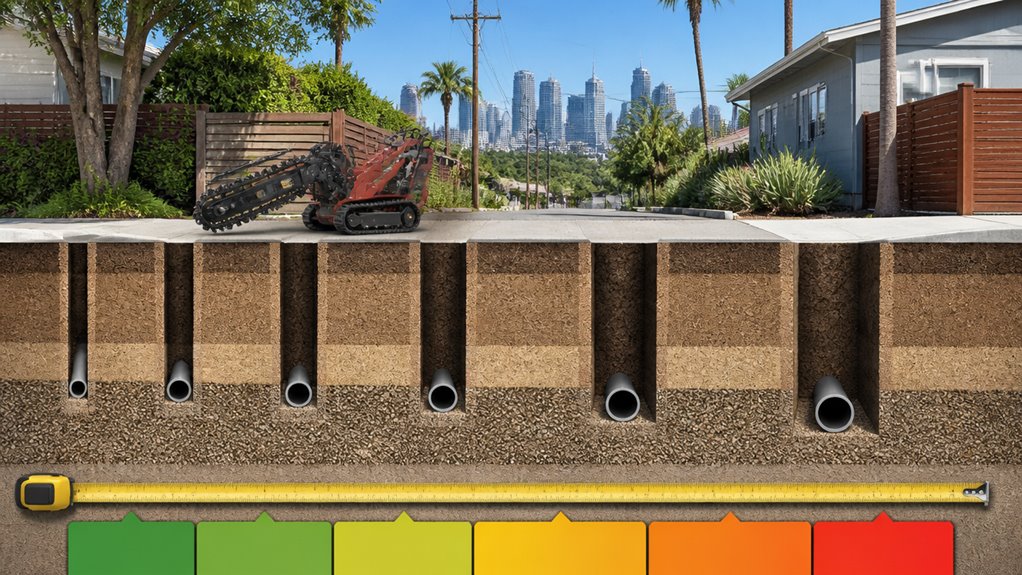
Budgeting water line trenching costs by trench length starts with understanding that price is usually quoted per linear foot, then adjusted by local conditions. In Los Angeles backyards, standard residential utility trenching often runs $5–$12/ft, while softer shallow digs can trend low and rocky or deep cuts can push higher. Longer runs raise total labor and machine time, so trench cost usually increases even when excavation techniques stay consistent. Water-line trenching can be quoted higher, sometimes $30–$50/ft, or more when full installation depth and restoration are included.
| Trench length | Typical standard trench cost | Notes |
|---|---|---|
| 1 ft | ~$8 | Minimum-charge effects |
| 50 ft | ~$500–$1,200 | Mobilization matters |
| 100 ft | ~$500–$1,200 | Scales predictably |
Los Angeles excavation budgets often cite $600–$3,000 overall, with many homeowners paying $400–$1,200 minimum.
Before any digging starts, the crew should contact 8-1-1 to verify utility locations, then maintain required depth and separation from other lines throughout the trench.
After excavation, they should inspect the trench bottom and keep it free of water, then confirm pipe alignment and grade before backfill begins.
This careful placement, along with correct bedding and haunching, helps the water line stay stable and prevents future settlement.
Clean trenching starts with controlling both depth and spacing so the water line stays protected and the system remains sanitary.
For Los Angeles, depth regulations require burying service lines at least 18–24 inches in normal soil, and at least 6 inches below the local frost line. The uppermost pipe projection must sit under at least 48 inches of finished grade.
At crossings, separation matters: sewer and water mains need at least 18 inches vertical spacing. In the same trench, sewer-to-water vertical separation should be about 12 inches.
For horizontal separation, potable water and non-sanitized water should stay 10 feet face-to-face, and sewer and water mains in parallel trenches need at least 6 feet.
Proper trench safety also means reassessing if fill depth triggers engineering review, and maintaining centered crossings.
Inspecting pipe placement before backfill keeps backyard water-line work sanitary, aligned, and compliant with approved plans. Once the trench is covered, corrections become expensive and destructive.
In Los Angeles projects, crews should follow an inspection checklist and meet compliance standards at the required hold point, since LA County Public Health approval is needed before backfilled recycled/reclaimed trenches. The utility trench should stay open until placement matches the plan, separation is verified, and any field corrections are completed.
Why risk delays or rework when trenching for a backyard project can be planned to match LADWP’s requirements from the start? They recommend coordinating the water service request before any excavation or service installation begins. Full payment is required before LADWP processes residential orders. Applicants provide the legal property description, residence address, requested service size, and a job-site contact person.
They then guarantee curb marking is completed: LADWP wants the service meter location painted “W” on the curb at the desired spot, or installation is delayed. For 2-inch and 3-inch services, a Cross-Connection Control Unit Survey form must be signed by an authorized LADBS representative.
| Step | Timing | Key detail |
|---|---|---|
| Request | Before digging | water service request |
| Payment | Before processing | full payment |
| Marking | Before scheduling | curb marking “W” |
| Permit | If sub-metering | DBS plumbing permit |
They also coordinate with the LADWP Construction Supervisor for site preparation.
LADWP water service approval typically takes about 90 calendar days for many small services, but around 140 calendar days for larger ones.
This water service timeline depends on the application process, BOE permitting conditions, and LADWP construction crew availability.
If trenching requires new water main installation, the schedule extends further, so planning for several months is safer.
For exact timing, homeowners should consult their Water Service Representative or District Engineer.
A “key” opens compliance: yes, he typically needs a licensed contractor for backyard trenching and plumbing when permits or licensing triggers apply.
California licensing rules and local permit practices often require a C-12 Earthwork and Paving or, for certain scopes, a Class A license.
This protects homeowners through licensed contractor benefits, and it guarantees trenching regulations are followed, especially near public ways, utilities, or when excavation and plumbing work exceed thresholds.
Extra shoring or different trenching equipment is needed when soil stability is poor or unpredictable.
Type C or disturbed soil, loose cohesion, and saturated ground increase cave-in risk, so tighter wall control may be required.
Trenches at about 5 feet or deeper often need protective systems like trench boxes, hydraulic shoring, or engineered shoring, especially near loads, roads, or vibration.
If soil type is uncertain, the safest approach is stronger protection.
Yes, but it should be avoided.
For example, a homeowner who opened a trench through large roots near a protected oak often triggered root-system damage, so the city required changes and mitigation.
In Los Angeles, protected trees (≥4 inches DBH, or combined trunks) are regulated, and work in the Tree Protection Zone must be approved by the DRP Arborist.
City rules limit cutting roots over 2 inches, and favor minimally invasive trenching techniques, like tunneling/boring to reduce tree root impact.
After backfill, the required backfill inspections typically confirm approved lift thickness, proper compaction density, and that drainage devices and any leak testing are passing.
Inspectors also check that concrete-encased or direct-buried conduit work remains acceptable before coverage continues.
Only after these backfill inspections are approved should the crew begin landscaping restoration, since rough-grade and drainage functionality must match the plans and pass any applicable grading approvals.
This sequencing prevents settlement and rework.
To sum up, successful water line trenching in Los Angeles depends on disciplined planning, starting with permits and ending with proper backfill. One especially useful statistic is that U.S. water leaks waste about 6 billion gallons per day, which makes accurate trench depth and secure installation more than just compliance. By verifying utility markings, maintaining sewer separation rules, and coordinating with LADWP when needed, homeowners can reduce rework and protect long-term service reliability.
Skip to content