
In Los Angeles, hillside excavation can become complex when lot slopes reach Baseline Hillside Ordinance thresholds, often requiring stricter grading limits and certified slope calculations. Those limits can force teams to rethink foundation design, such as using caissons instead of spread footings to stay within allowable cut and fill. Costs rise with excavation, export, swell factors, and permit fees, while haul routes may need approval. Geotechnical data guides bearings, remedial work for expansive clay, and drainage plans, plus stormwater and tree compliance.
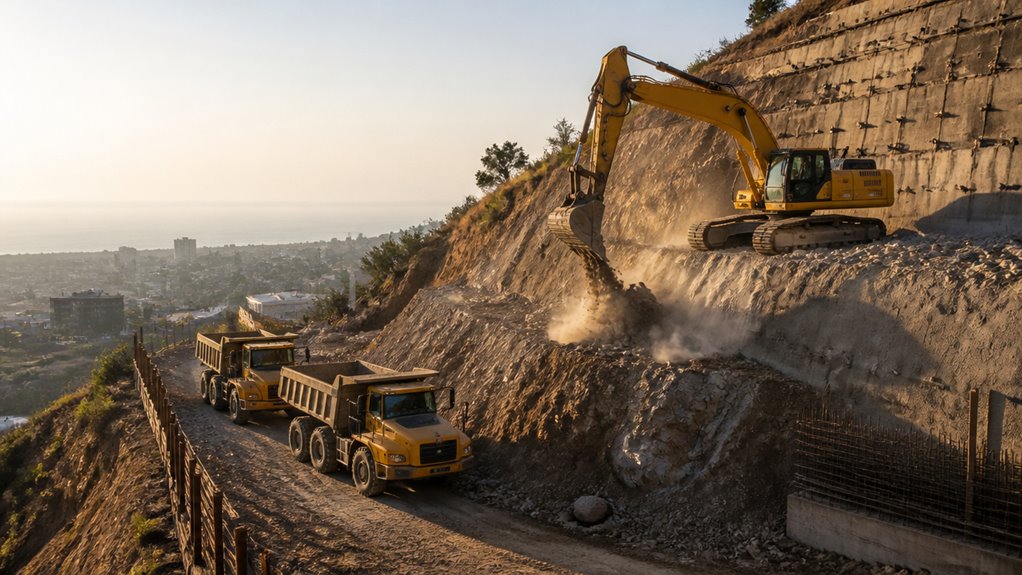
In Los Angeles, hillside excavation rules can begin to apply quickly once a property crosses certain slope and zoning triggers, and this is a major reason why hillside projects require early planning.
Properties with natural slopes of 15% or more, based on USGS topographic data, fall under Baseline Hillside Ordinance requirements, which are part of broader hillside regulations.
Zoning designations with hillside suffixes, such as R1-H or RE-H, can activate requirements even if the slope seems modest.
Multi-family zones on slopes above 5% also trigger protection.
City mapping systems and Hillside Area Maps determine applicability, so a lot may shift from non-regulated to regulated solely when the measured slope threshold is exceeded.
In these cases, excavation permits typically face stricter review.
Because excavation work is high-risk, fully insured contractors help protect clients from liability while work is performed under these more demanding conditions.
First, a property owner must determine the lot slope percentage using the required Slope Analysis Map, because hillside designation often begins at 15% and the slope bands influence permitting calculations. Next, they apply the baseline hillside grading limit by combining the 500 cubic yard base with an additional allowance equal to 5% of the total lot size in cubic yards, remembering this cap is based on combined Cut and Fill quantities rather than net change. Finally, the calculated amount is compared against zone-specific “by-right” limits from the applicable ordinance table, since those caps can restrict the maximum grading even when the formula suggests a higher number. This is why excavation contractors focus on rough grading to create the level or sloped surface needed for compliance.
To determine a hillside lot’s grading limit, the starting point is calculating the lot slope percentage using measured terrain data.
Using slope measurement techniques, the evaluator divides vertical rise by horizontal distance between two points, where vertical rise equals the highest point minus the lowest point. The highest and lowest elevations must be found through topographic survey work, with careful elevation point identification across the entire lot, not just a quick spot check.
Next, the linear distance between the extreme elevation points is measured, then the formula (Highest Point − Lowest Point) ÷ Distance Between Points = Slope % is applied.
A California registered Civil Engineer or Licensed Land Surveyor must prepare and certify the calculations, including license number and expiration date.
Once the lot slope percentage has been established, the next step is using the Baseline Hillside Formula to calculate the maximum hillside grading limit for the property. The approach starts with a base maximum of 500 cubic yards, then adds 5% of the total lot size, converted to cubic yards. It applies to all cumulative cut and fill, including incremental work on the same lot, and it supports grading regulations that manage environmental impact. For single-family residential zones in designated Hillside Areas, the calculated limit guides permit feasibility, since grading permits wait for building permit approval. The example below shows how the base and percentage combine.
| Component | Quantity |
|---|---|
| Base maximum | 500 yd³ |
| Plus allowance | 5% lot (yd³) |
| Example lot (5,000 sf) | 750 yd³ |
How can a property owner estimate the maximum hillside grading allowance before detailed engineering begins? First, they compare baseline and slope-based options using local grading regulations and a clear slope analysis map.
For standard eligible zones, the estimate starts with 500 cubic yards, then adds 5% of lot size in cubic yards. A 5,000 square-foot lot illustrates this, totaling 750 cubic yards (500 + 250).
Next, zoning caps can override the uniform estimate: R1 allows 1,000, RE9 allows 1,200, RE20 allows 2,400, RE40 allows 3,300, and RA allows 1,800.
Finally, if slopes are 30% or steeper for 60% or more, the minimal grading option applies, limiting grading to 10% of lot size or 1,000 cubic yards, whichever is less.
When a hillside lot has tight grading limits, the choice between conventional spread footings and caisson foundations can make or break the project’s feasibility.
During foundation selection, crews must align excavation techniques with Los Angeles grading rules that are set early in schematic design.
Conventional spread footings often demand extensive pad grading, which uses more of the grading allowance and can trigger regulatory follow-ups like ZAD applications.
On many LA slopes over 20%, geotechnical guidance pushes designers toward caissons.
Caisson excavation may be exempt from cumulative BHO totals, so the project can stay within limits even when more total earth is removed.
However, professional grading exempt remedial grading applies only to removal below existing grade, and exported material still brings logistics demands.
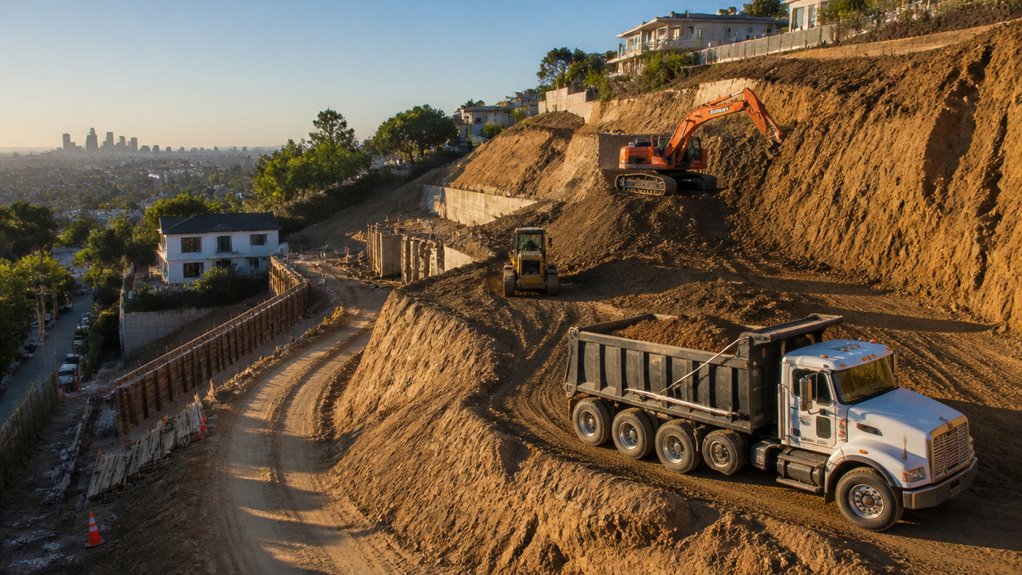
Budgeting hillside excavation requires looking beyond the “in-place” yardage shown on early estimates and separating it from what must actually be moved, hauled, and processed off site.
Basic cost estimation can start with $10–$25 per cubic yard in place, but excavation budgeting must add $15–$30 per cubic yard for material export, because trucking to disposal facilities is often unavoidable.
Swell factor of 20–30% means 1,000 in-place yards may require 1,200–1,300 yards of capacity.
Grading permits for work over 50 cubic yards, plus hillside regulations tied to slope percentage, can run $8,000–$45,000 and shift project timelines by 12–26 weeks.
Soil stability, site access limits, and foundation types such as caissons influence excavation techniques and raise export volumes.
Controlling haul routes and accounting for swell factor are two of the most practical ways to prevent hillside excavation delays before they start.
In Los Angeles, swell factor can increase loose volume by 20–30%, so a 2,000-cubic-yard in-place excavation may require 2,400–2,600 cubic yards of export volume, raising trucking capacity needs and disposal costs.
This directly affects project budgeting and excavation planning, since bids priced on in-place quantities often understate hauling by the same 20–30%.
Haul route approval is required for export volumes over 1,000 cubic yards, with DPW review in 21 days and possible hearings within 45 days.
Deputy inspectors perform compliance checks by counting trucks and verifying approved haul routes, supporting correct soil management and timing.
Geotechnical bearing results help teams plan which remedial grading steps are truly needed, and how to size and place engineered fill so loads stay within the intended support zone.
By identifying limitations like expansive clay behavior and depth of bearing material, the design can balance shallow versus deep foundation options while reducing risk of over-excavation surprises.
With these data in hand, the project can set practical excavation and compaction requirements, helping keep hillside construction both safer and more efficient.
Because hillside ground conditions set the limits for what foundations can safely support, geotechnical results largely determine both bearing design and the remedial grading scope.
In Los Angeles, geotechnical challenges from varied bedrock, colluvium, and undocumented fill force engineers to verify foundation stability early. Boring data and lab tests establish soil bearing strength, while LADBS requires certified foundation plans tied to those subsurface findings.
With slope factors meeting code requirements, the planned remedials match the actual ground conditions.
A key challenge in Los Angeles hillside construction is limiting the impact of expansive clay, since it can swell 10 to 30 percent as moisture changes and then shrink during dry periods.
With cyclical movement, the expansive soil can create differential expansion, driving floor heave, wall shifts, and foundation cracking.
Geotechnical testing before excavation helps identify highly expansive CH clay using borings, Atterberg limits, and swell-pressure results.
Engineers then use those geotech findings to guide soil remediation steps, including removing unsuitable material and placing certified fill to achieve reliable bearing.
For foundation stability, the plan relies on adequate factors of safety for static and, when required, seismic conditions, so structures resist uneven uplift.
Early, data-based decisions reduce long-term repair costs.
How should a hillside project decide between shallow foundations and deep foundations in Los Angeles, given that soil conditions can vary sharply from the slope face to the building footprint?
Geotechnical reports drive the choice by comparing stratification, groundwater, and hazards, and they direct soil testing for bearing and remedial planning. In expansive clay zones, mat foundations or deep piers may be needed to achieve reliable support.
Where liquefiable loose sands or shifting colluvium occur, caissons anchor the structure to resist settlement and lateral movement. In some areas, shallow bedrock complicates drilling and can require alternative foundation types.
Key checks include:

Staying compliant with stormwater rules and protected tree requirements is essential for hillside excavation projects, because both areas directly affect water quality and long-term site stability.
Proper tree preservation supports ecological compliance, while stormwater management and erosion control reduce sediment runoff. A SWPPP, often paired with SUSMP requirements, guides construction planning, including LID methods like infiltration and bioretention.
Onsite systems must be sized to infiltrate, store, treat, and keep discharge within site boundaries when feasible.
Meanwhile, grading regulations limit slope ratios and restrict cut areas, shaping site logistics and construction planning decisions. Protected species may trigger biological surveys, TPZ limits on equipment, and arborist-supervised grade changes.
Permits can take 90 to 120 days, so early environmental impact checks prevent delays.
A hillside grading permit is typically required even if excavation stays under 50 yards, because hillside design triggers enhanced scrutiny.
A permit may be waived only if the site is relatively level and approval is granted by the Department of Building and Safety.
If the work is entirely for footings and grade beams up to 5 feet deep, a waiver is more likely.
Any change to drainage, even small, can override the exemption.
Proper excavation techniques protect hillside stability.
To determine a lot’s slope percentage for ordinance requirements, first identify the highest and lowest elevations on the parcel using a stamped survey.
Then measure the linear distance between those points.
Compute slope as (Highest − Lowest) ÷ Distance, expressed as a percentage, and do not round up.
This slope measurement determines whether the lot falls in the 0–45% or >45% band, which controls the correct maximum RFA table.
To choose caissons versus spread footings, a licensed geotechnical engineer gathers soil composition, groundwater data, and stratification from borings. They then evaluate load capacity for both foundation types.
They also measure bedrock depth, expansion potential, liquefaction risk in seismic zones, and differential settlement potential. Laboratory tests should confirm bearing capacity and swelling characteristics, while slope movement and lateral forces determine whether deep anchoring is necessary.
Over-excavation raises total cost and export volume by increasing how much loosened soil must be hauled away.
Using swell calculation, crews convert bank volume to loose truck volume, often adding 20–50% more material.
If R&R and moisture conditions require removing unsuitable soils, additional export becomes unavoidable.
That swell-driven cost impact affects dump counts, haul routes, and disposal fees, so small bid errors can quickly become major losses.
Typical LADBS plan check or haul-route approval delays often stem from regulatory bottlenecks and documentation errors.
Missing or incomplete haul-route details, such as street designations, operating hours, dust control, or spillage mitigation, commonly trigger resubmittals.
Interdependent traffic and street-assessment reviews from other agencies can extend timelines, especially when responses are sequential.
Exceeding haul-volume thresholds also forces extra approvals.
Additionally, absent or outdated grading and geotechnical supporting documents slow reviewers’ decisions.
Hillside excavation in Los Angeles demands careful timing and smart decisions. First, teams calculate grading limits by slope, then they select footings or caissons to protect those limits. Next, they budget in-place versus export costs, and they control haul routes using swell factors to prevent delays. Finally, geotech results guide bearings and remedial work, while stormwater rules and protected trees keep projects compliant. When planning is precise, challenges become manageable, progress stays steady.
Are you aware that improper excavation can lead to significant structural issues down the line? If you’re a homeowner in Los Angeles, the importance of reliable residential excavation cannot be overstated. This article aims to guide you through the complexities of excavation, addressing common challenges such as compliance with local building codes and ensuring long-term stability for your property. Whether you’re planning a new construction, renovation, or landscaping project, understanding the nuances of site preparation is crucial. We’ll explore the factors that influence costs, such as terrain and soil conditions, and why hiring licensed and insured contractors is essential for your peace of mind. By the end, you’ll be equipped with the knowledge needed to choose reputable contractors, ensuring the success of your excavation project. Let’s dive in and discover how to navigate this vital aspect of home improvement in Los Angeles.

When starting a construction project in Los Angeles, why is it essential to hire professional excavation services?
These experts ensure compliance with local building codes, which helps minimize potential delays and legal issues. Their proficiency in handling heavy machinery reduces the risk of accidents significantly, while quality excavation work prevents future structural problems by properly preparing the site, ensuring effective drainage and stability.
By trusting professionals in excavation services, you’re setting the stage for a successful construction project.
For more insights on selecting the right contractor, see our guide on hiring construction professionals.
Understanding the factors that influence excavation costs can help you better prepare for your residential project in Los Angeles.
But have you considered how permits and regulations might also impact your overall expenses?
Exploring these legal requirements is essential for accurate budgeting and successful project execution. Additionally, understanding the importance of proper equipment utilization can also affect the efficiency and cost of your excavation project.
Understanding the terrain and soil conditions in Los Angeles is crucial for effective excavation planning. Rocky or uneven terrain generally leads to increased costs due to the need for specialized machinery and additional labor. In contrast, flat or sandy soil usually requires less effort, making it more cost-effective.
Additionally, soil stability and drainage play key roles in project complexity. Heavy clay or wet soil can complicate the excavation process, leading to longer timelines and higher expenses.
Accessibility also matters; remote locations may require extra resources for equipment transport, further impacting the budget. Professional operator expertise can significantly enhance the efficiency of the excavation process, ensuring that challenges related to terrain and soil conditions are effectively managed.
For more insights on managing excavation challenges, see our guide on best practices for residential projects.
The size of an excavation project in Los Angeles significantly affects its total cost. Larger jobs necessitate more labor and equipment, which directly increases expenses.
Extensive grading and site clearing for sizable projects amplify the demand for resources, thereby inflating overall costs.
Understanding the scale of your excavation project is crucial for accurate budgeting.
For a deeper dive into estimating costs effectively, refer to our guide on residential excavation planning.
Site accessibility plays a crucial role in determining excavation costs. Difficult-to-reach locations may necessitate additional labor and specialized equipment, leading to increased expenses.
For instance, narrow streets or spaces with limited machinery access can complicate operations, raising labor hours and logistical challenges.
Moreover, the terrain type significantly influences equipment choices. Uneven or rocky landscapes typically require more robust machinery, such as bulldozers or excavators, which can further elevate costs.
Additionally, compliance with local regulations may require specific tools to adhere to safety standards.
Understanding these variables is essential for effective planning. For more insights, refer to our guide on budgeting for excavation projects.
Preparing a site for residential construction involves essential clearing and grading tasks to ensure a stable foundation.
But what’re the specific steps involved in foundation excavation that guarantee your home’s long-term support?
Understanding these techniques is crucial for successful site preparation and effective drainage.
Preparing land for construction requires careful clearing and grading. First, hire a skilled excavation contractor to remove debris, vegetation, and any old structures, ensuring the site is ready for subsequent work. This initial step is crucial for effective grading, which creates a stable surface for your dream home.
Grading involves both rough and fine techniques. Rough grading shapes the overall landscape, while fine grading makes precise adjustments for landscaping and foundation needs. Proper grading also aids in drainage, preventing water accumulation around your home and stabilizing the soil to avoid future settling.
For further insights on site preparation, check out our guide on foundation laying essentials.
To achieve a stable base for your home, it’s crucial to follow precise foundation excavation techniques. Start by carefully digging to the specified depth and dimensions, ensuring that the foundation remains level and aligned.
Engaging experienced contractors is essential, as they utilize heavy machinery like excavators and backhoes for efficient earth removal.
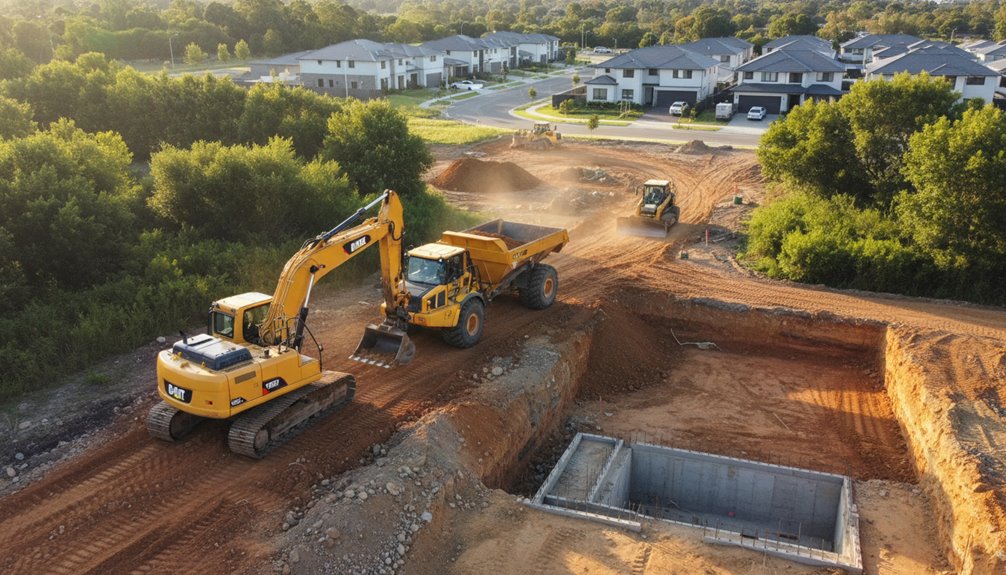
For homeowners embarking on residential construction projects, mastering excavation techniques is crucial for ensuring a stable build.
Begin with site clearing, removing vegetation and any existing structures to prepare the land. This is followed by rough grading to create a level or gently sloped surface, which promotes proper drainage and stability.
Next, focus on foundation excavation, digging to the appropriate depth and dimensions for a solid base.
Dig to the correct depth and dimensions to ensure a stable foundation.
After foundation installation, backfilling is necessary to refill excavated areas, providing structural support.
While these tasks can seem straightforward, enlisting professional excavation services can help avoid costly repairs and ensure compliance with local building codes and standards.
To learn more about excavation methods, see our guide on effective site preparation.
When planning a residential excavation project in Los Angeles, it’s crucial to understand local regulations and permits.
Start by securing necessary permits from the Department of Building and Safety to ensure compliance with zoning and safety standards.
Skipping permits can lead to fines and project delays, impacting future property development.
For further insights, see our guide on obtaining construction permits efficiently.
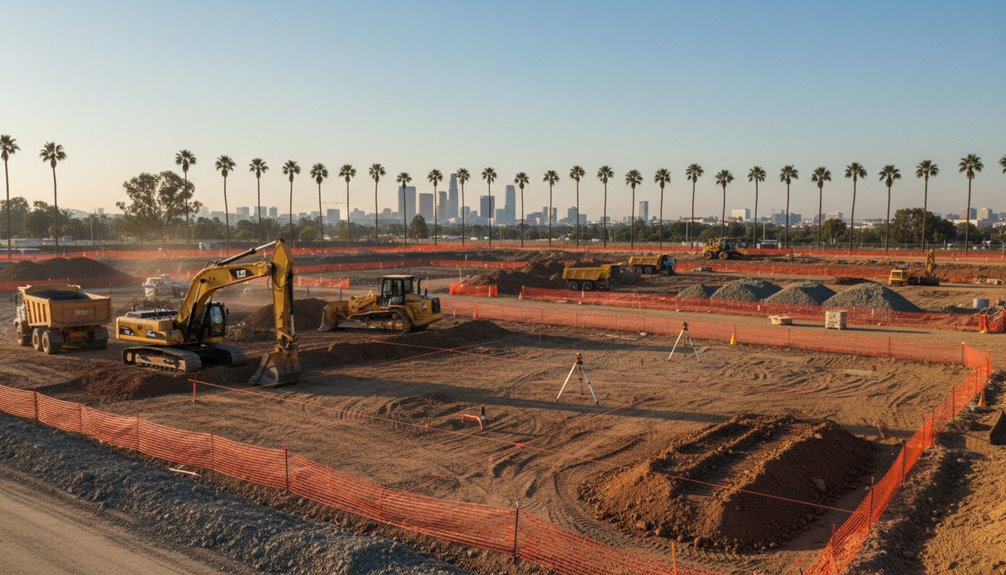
Finding a reputable excavation contractor involves a few key steps. First, ensure that the contractors you consider are licensed, insured, and bonded, which protects you from potential liabilities.
Seek out reviews from previous residential clients on platforms like Angi to assess their work quality and customer satisfaction.
Proper grading is crucial for ensuring safety and stability in residential excavation projects. It facilitates effective drainage, which minimizes the risk of water pooling and subsequent foundation problems.
Ensuring safety in excavation begins with proper grading to prevent water pooling and foundation issues.
Additionally, conducting soil stability assessments helps prevent structural issues that may arise from shifting or settling soil.
By following these steps, you can create a safer environment for future construction.
For more in-depth strategies, refer to our guide on effective site preparation.
In summary, selecting the right contractor for residential excavation is crucial to avoid costly mistakes and ensure structural integrity. By applying the strategies outlined in this article, you can save significant money and time while enhancing safety and stability in your project. Understanding local regulations and excavation techniques not only protects your investment but also leads to a more efficient site preparation process. As you move forward, consider exploring more tips or reading related guides to deepen your knowledge on residential excavation Los Angeles. Taking these steps will position you for success in your home improvement endeavors.
Are you aware that improper dirt disposal can lead to hefty fines and environmental harm in Los Angeles? If you’re a contractor, homeowner, or landscaper facing the daunting challenge of removing excess dirt from your site, exploring affordable dirt hauling services in Los Angeles could be your solution. Not only do these services provide budget-friendly options starting at around $115, but they also incorporate eco-friendly practices that benefit both you and the community. This article will guide you through the various roll-off dumpster sizes available, the efficiency of same-day scheduling, and the skilled teams equipped with professional tools like Bobcats for precise dirt removal. By the end of this read, you’ll understand how these expert solutions can enhance your project’s efficiency while prioritizing sustainability. Join us as we delve into the world of dirt hauling, where value meets environmental responsibility.
Offering roll-off dumpsters for projects of all sizes, with convenient online booking for hassle-free dirt removal.


Did you know that nearly 50% of homeowners in Los Angeles consider enhancing their outdoor space with a pool? Transforming your property through pool excavation not only creates a stunning focal point but also significantly boosts your property’s value. This article is designed for Los Angeles homeowners who are contemplating this dynamic upgrade but may feel overwhelmed by the complexities of the process. From choosing a licensed and insured contractor to navigating local regulations and permits, we will guide you through each crucial step. Additionally, we’ll explore eco-friendly excavation practices that align with modern sustainability standards. By the end of this article, you’ll have a clear understanding of how to embark on your pool excavation journey, unlocking exciting landscaping possibilities that await your backyard oasis. Dive in and discover how you can elevate your outdoor living experience!

To ensure a successful pool excavation, start with a thorough site assessment to determine the best demolition approach.
Securing the necessary permits is critical for compliance with local regulations and safety standards.
Heavy machinery will then be utilized to excavate the pool shell, plumbing, and surrounding materials effectively.
Understanding these steps is essential for a smooth project execution. Additionally, engaging a top excavating contractor can provide invaluable expertise throughout the process.
For more detailed guidance, refer to our comprehensive guide on pool removal services.
Removing an unused pool not only enhances your property’s value but also opens the door for creative landscaping possibilities.
Have you ever considered how transforming that space could elevate your outdoor aesthetics and functionality?
Exploring different options for your yard can lead to a more inviting environment while ensuring safer outdoor experiences for everyone.
Removing an unused pool can significantly elevate your outdoor living area. By eliminating the pool structure, you free up space for new landscaping ideas, such as vibrant gardens or cozy patios perfect for gatherings.
This transition not only enhances the aesthetic appeal of your property but also improves safety by removing drowning hazards. Additionally, excavation services can ensure that the area is properly graded and prepared for your new landscaping plans.
As you consider these benefits, it’s also worth exploring ways to maximize your new outdoor space.
For further insights, check out our guide on outdoor design ideas.
Eliminating an unused pool in Los Angeles can significantly decrease your maintenance expenses. The annual costs for pool upkeep, including chemicals and repairs, typically range from $1,200 to $2,000.
By removing the pool, you can save 20-30% on your water and electricity bills, as well as avoid potential costly repairs from structural damage, which can be anywhere from $500 to $5,000.
Additionally, without a pool, you may lower your insurance premiums, as pools often elevate liability risks by 10-15%.
This decision not only cuts costs but also allows you to repurpose the space for more practical uses, enhancing your backyard’s functionality. Moreover, the savings in excavation services can contribute to funding other home improvement projects.
For more insights on optimizing home maintenance, check out our guide on reducing household expenses.
Eliminating an unused swimming pool can significantly enhance your property’s value, especially in competitive markets like Los Angeles. By transforming this space into a functional area, homeowners can see a value increase of up to 20%.
For more insights on boosting your home’s marketability, check out our guide on effective home improvements.
Selecting an excavation contractor for pool demolition in Los Angeles is crucial for a successful project.
Choosing the right excavation contractor is vital for a successful pool demolition project.
Start by ensuring the contractor is licensed and insured, safeguarding your property. It’s advisable to hire specialists in pool excavation, as their expertise with various materials and types can significantly enhance efficiency and results.
By following these steps, you’ll be better equipped to find a contractor that aligns with your project needs.
For further information on excavation best practices, see our guide on hiring contractors.
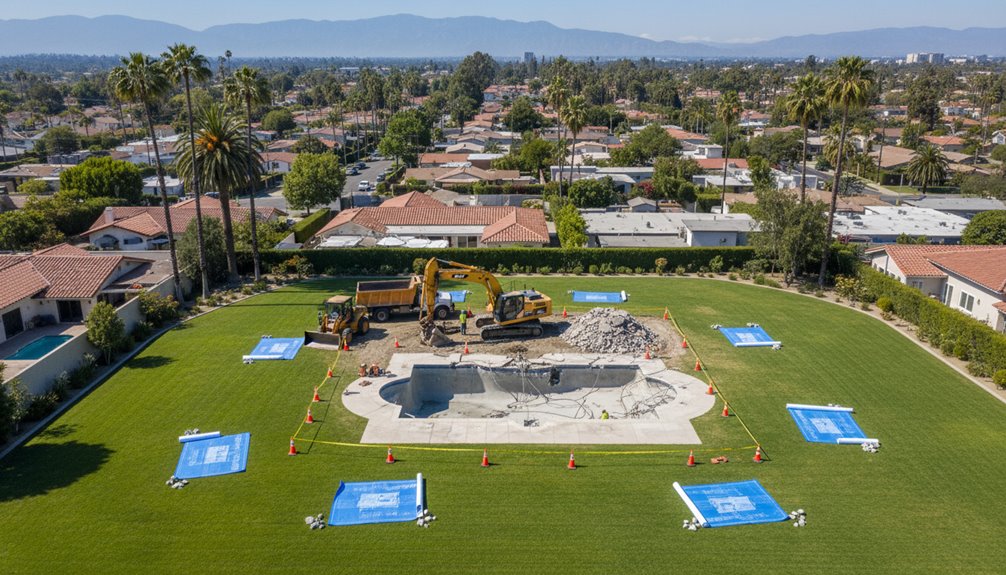
Obtaining the correct permits is crucial for a seamless pool demolition in Los Angeles, ensuring compliance with local regulations.
Are you aware of the specific requirements for your area, and how a licensed contractor can simplify the process for you?
Understanding these regulations can save you from potential complications and fines.
Initiating a pool demolition project in Los Angeles involves obtaining specific permits to ensure compliance with local building regulations.
First, it’s crucial to secure the necessary local authority permits by submitting detailed demolition plans.
Additionally, homeowners must verify any homeowner association (HOA) regulations that could impact the demolition process.
Key steps include:
Failing to obtain these permits can lead to fines and project delays.
For further guidance on navigating permits, refer to our comprehensive guide on construction regulations.
Navigating the pool demolition permit process in Los Angeles can be simplified by understanding the necessary steps. First, obtaining a permit from the Department of Building and Safety is crucial to ensure adherence to local building codes.
Submit a detailed application outlining your project’s scope, and check for any additional regulations regarding environmental concerns or utility disconnections.
Following these steps will help avoid fines and complications, ensuring a smooth demolition process that protects your property’s value.
For more information on local regulations, see our guide on compliance with building codes.
Eco-friendly pool removal in Los Angeles County requires careful planning and adherence to environmental regulations.
Careful planning and adherence to environmental regulations are essential for eco-friendly pool removal in Los Angeles County.
Start by obtaining the necessary permits to ensure compliance with waste disposal and ecological standards. Assess for hazardous materials such as asbestos or lead, particularly in older pools, as they require specialized handling.
Taking these steps not only protects the environment but also helps maintain community standards.
For more detailed information on securing permits, see our guide on local regulations.

When budgeting for pool excavation in Los Angeles, several cost factors come into play. The size and type of pool are crucial, as in-ground pools typically incur higher removal costs compared to above-ground options.
Additionally, permits are necessary and can vary based on local regulations, impacting overall expenses.
Moreover, site complexity is a significant factor; issues like accessibility and existing structures can lead to increased labor and equipment costs.
On average, pool demolition services range from $3,000 to $15,000. To accommodate various budgets, many companies provide flexible payment options and detailed upfront quotes, fostering transparency throughout the process.
For more insights on managing your pool excavation budget, see our guide on effective cost-saving strategies.
Post-pool excavation, your outdoor area can be revitalized into a beautiful and functional space.
With the old pool removed, consider innovative landscaping options like new gardens or patios that reflect your style.
Explore new gardens or patios to express your unique style post-pool removal.
Incorporating hardscaping elements, such as elegant walkways or cozy fire pits, can create a welcoming atmosphere for gatherings.
Thinking about these ideas will help you maximize your outdoor transformation.
For more tips on landscaping designs, check out our guide on creating stunning outdoor spaces.
Transforming your outdoor space through pool excavation is a pivotal step towards creating a stunning home environment. By following the strategies outlined in this article, such as selecting the right contractor and managing necessary permits, you can ensure a seamless process that enhances both the aesthetics and value of your property. Considering environmental factors and cost options further empowers you to make informed decisions that align with your vision. As you embark on this journey, why not explore more tips or read related guides to maximize your backyard’s potential? Taking that first step can lead to a beautiful oasis right outside your door.
Skip to content