
Grading is essential in construction as it lays the groundwork for stable structures, ensuring the foundation’s strength and safety. It’s all about reshaping land, handling drainage, and preventing structural issues like cracks and settling. By conducting site analysis and using equipment like bulldozers, you create a solid base. Grading influences project success by enhancing aesthetics, boosting value, and speeding up timelines. Explore further to uncover the challenges and solutions that make grading indispensable.

When it comes to construction, grading is much more than just moving dirt around—it’s vital for a project’s success. You’ll find that grading benefits your construction project by ensuring foundation stability. Proper grading supports load-bearing capacity and helps prevent settlement issues and foundation cracks.
By compacting soil, you create a solid base, distributing weight evenly to avoid structural damage. However, grading challenges include managing uneven terrain, which can lead to uneven settling. You also need to conduct soil composition analysis to decide where to compact or excavate for strength.
Effective grading also addresses drainage management, redirecting water flow to prevent pooling and erosion. Furthermore, employing professional excavation services can significantly enhance the grading process, ensuring compliance with local regulations and safety standards. Remember, understanding grading’s importance is significant in overcoming the challenges and reaping its benefits.
Grading’s importance in construction is clear, but understanding its key components is just as vital for project success.
You’ll start with a thorough site analysis and survey, which includes land surveys to map the existing topography and soil composition. This step guarantees soil stability and identifies utility lines, flood zones, and seismic risks.
Regulatory compliance is essential; you’ll need permits, earthwork estimates, and erosion control plans.
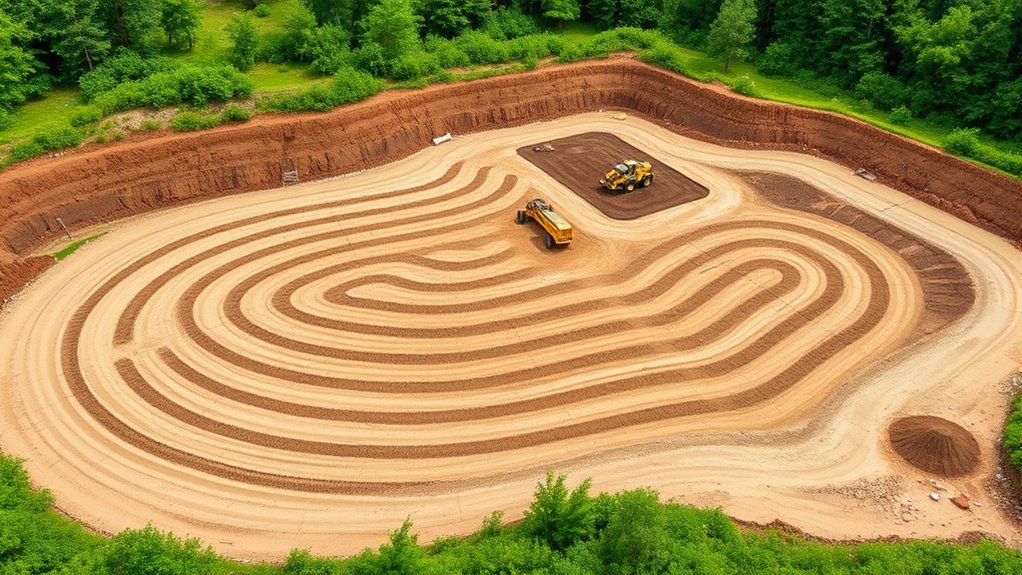
Grading methods rely heavily on grading equipment like excavators, bulldozers, and motor graders to reshape the landscape.
Elevation marks and contour lines guide the process, guaranteeing that the final layout supports effective drainage and aligns with environmental considerations. Additionally, effective site clearing is crucial to ensure the land is properly prepared before grading begins.
Proper planning and execution of these components guarantee a solid foundation for any construction project.
In the world of construction, understanding the various types of grading techniques is essential for a successful project. Among these, rough grading stands out as a vital grading method.
It involves the initial site preparation by clearing vegetation and debris, and using grading equipment like bulldozers and graders for large-scale soil movement. This technique establishes foundational levels and drainage channels, ensuring structural support and stability before the foundation work begins.
It’s essential for setting up watershed directions to prevent water pooling near structures. Once rough grading is complete, finish grading comes into play. This method focuses on refining surfaces by removing any leftover debris and smoothing out the terrain, ensuring the site is ready for the next construction phase.

Grading plays an essential role in preparing a construction site for successful project execution. By utilizing grading tools, you can achieve soil stabilization through compaction, guaranteeing the foundation’s load-bearing capacity.
One of the grading benefits is creating stable bases, which prevents settlement and potential damage to buildings. Establishing elevation benchmarks aids in precise construction of foundations, walls, and pavements, while adhering to zoning laws and environmental regulations.
Additionally, grading guarantees effective drainage management by directing water away from structures, preventing erosion and pooling. Efficient grading minimizes rework and optimizes material use, accelerating timelines and reducing costs.
When tackling grading challenges in construction, you need to focus on terrain evaluation techniques to accurately assess the land’s topography and potential obstacles.
Addressing soil stability issues is vital, as unpredictable conditions can lead to structural risks and compaction difficulties, especially in clay or sand-heavy areas.
To guarantee effective water management, implement drainage system solutions that prevent runoff and protect nearby properties from erosion and moisture imbalances.
Although grading in construction projects seems straightforward, evaluating terrain poses significant challenges that require innovative solutions. Inaccurate topographic surveys can lead to costly drainage and slope errors. Using GPS and LiDAR technology helps improve accuracy. Landform analysis and surface modeling are essential for handling variable elevation changes, enabling you to visualize and plan the land reshaping process effectively. GIS tools are crucial for examining natural drainage patterns, while pre-grading site surveys help identify existing utility-site conflicts. Contour line misalignment can risk improper grading plans, necessitating precise alignment techniques.
Here’s a quick overview:
| Challenge | Solution |
|---|---|
| Inaccurate Surveys | GPS and LiDAR |
| Elevation Changes | 3D Surface Modeling |
| Drainage Patterns | GIS Tools |
| Contour Misalignment | Precise Alignment |
| Utility Conflicts | Pre-Grading Surveys |
Evaluating terrain accurately is just the beginning; understanding soil stability issues is equally important in effective grading.
High clay content can lead to soil erosion and foundation instability as it expands and contracts with moisture changes. Poor compaction increases voids, risking structural integrity. If organic matter isn’t thoroughly removed, it can hinder load-bearing capacity.
Inconsistent fill material or underground obstacles like rock layers might disrupt your grading plans, affecting foundation stability. To counter these challenges, conduct soil composition tests and load-bearing assessments.
Dynamic compaction techniques, geosynthetic reinforcement, and soil replacement are effective solutions. Following local building codes and environmental regulations helps maintain safety and stability, ensuring your construction project’s success and longevity.
Effective drainage systems are essential in grading projects, addressing numerous challenges that can jeopardize a site’s stability and safety.
Without proper drainage solutions, you might face pooling and water accumulation near foundations, risking structural damage. Erosion on slopes can lead to landslides, especially in hilly areas. Insufficient sloping may cause flooding, while poor stormwater management might carry pollutants, violating environmental regulations.
Complex multi-lot projects further complicate grading solutions due to neighboring properties’ stormwater.
To tackle these issues, consider using swales and bioswales to filter and redirect water. Install underdrain tile systems to prevent pooling. Permeable surfaces can reduce runoff, while retention ponds manage excess water.
For steep areas, grading-specific retaining walls and slope grading effectively mitigate erosion.
You know that grading is essential for your project’s success because it guarantees structural integrity and stability by providing a solid base for your buildings.
Proper grading also prevents water accumulation, which can lead to costly damage and delays, while enhancing the aesthetic appeal of the finished project.
Grading plays a pivotal role in guaranteeing structural integrity, greatly impacting the success of construction projects. By focusing on foundation reinforcement and load distribution, proper grading prevents foundation cracks and guarantees even weight distribution across the site. This creates a stable base that avoids settling or shifting over time.
Grading addresses uneven terrain by redistributing soil to match design specs, supporting heavy-duty infrastructure like bridges or buildings. Through compaction processes, air pockets are eliminated, strengthening soil density. Identifying and correcting soft spots prevents localized settling, guaranteeing uniform bearing capacity.
Compliance with standards is essential—grading meets building codes and passes inspections, aligning with municipal regulations. Strategic grading also mitigates environmental pressures, adapting to site-specific challenges early in planning.
When it comes to construction projects, preventing water accumulation is essential for long-term success and structural integrity. Effective water management starts with proper grading techniques, following specific grading regulations.
Design slopes with a 5-10% incline away from foundations to guarantee water doesn’t pool near structures. Direct runoff toward storm sewers or natural channels, not neighboring properties, and compact filled soil to maintain slope consistency.
Use French drains or grassy swales to handle subsurface and surface water flows. Adhere to local ordinances by guaranteeing minimum slope distances from foundations and obtaining stormwater permits.
Incorporating thoughtful grading techniques into construction projects doesn’t just prevent water issues; it also enhances the aesthetic appeal, considerably influencing project success. By harmonizing structural and landscape features, you achieve a landscape harmony that complements your building’s design. Think of how aesthetic balance is reached when buildings integrate seamlessly with surrounding vegetation, creating cohesive themes. Strategic grading resolves visual conflicts, ensuring symmetry between hardscape and softscape elements.
| Emotive Aspect | Impact on Design |
|---|---|
| Cohesive Visual Themes | Integrates buildings with nature |
| Symmetry | Balances hardscape and softscape |
| Visual Conflicts | Resolves between construction and nature |
| Elevated Interest | Uses terraces and raised beds |
| Property Value | Enhances curb appeal |
These efforts increase property value and maintain neighborhood consistency, making your project a visual delight.
With these steps, you’re set for successful grading.
Grading in construction projects greatly influences your project’s success, ensuring stability, safety, and seamless site preparation. By embracing effective grading techniques, you enhance efficiency and eliminate potential pitfalls. With careful consideration of challenges and solutions, grading becomes a gateway to greatness, setting a solid foundation for future phases. Implementing best practices, you pave the path to perfection, minimizing risks and maximizing results. In construction, grading is not just groundwork; it’s the groundwork for greatness.
Skip to content