
To select the right equipment for debris removal, start by evaluating site conditions, considering factors like hazardous materials and terrain. Match equipment to these conditions—compact excavators prevent damage in urban areas, while skid steer loaders are great for tight spots. Emphasize operator safety with clear visibility and trained personnel. Integrate versatile machinery for different debris types and guarantee cost-effectiveness through efficient equipment selection. Streamlining your choices enhances efficiency and saves resources, uncovering more strategic insights.

When planning debris removal, understanding site conditions and requirements is vital for a successful project. Start with a thorough site assessment to evaluate environmental factors, like pollution sources and water presence, which could complicate removal efforts.
Conduct a comprehensive site assessment to identify environmental factors affecting debris removal.
You’ll need to classify debris accurately to decide how to handle each type, especially when dealing with hazardous materials or invasive species. Consider subsurface conditions—underground storage tanks or buried contaminants might need specialized approaches.
Don’t overlook the importance of identifying cultural or historical artifacts on the site, as these require careful documentation and preservation protocols. Regulatory compliance is key; make certain you secure necessary permits and coordinate with relevant agencies. Additionally, engaging experienced excavating contractors can significantly enhance the efficiency and safety of the debris removal process.
This strategic planning guarantees a smooth, efficient debris removal process.
Understanding the capabilities and limitations of debris removal equipment is essential for maximizing versatility and overcoming terrain-specific challenges.
You need to match equipment to the site conditions; for example, while skid steer loaders excel in tight spaces, articulated dump trucks are better suited for rugged terrain.
Recognizing these differences helps you select the right machinery, ensuring efficiency and safety on the job site. Additionally, understanding the importance of bobcat services can further enhance your project’s success by providing versatile machinery options tailored to specific tasks.
In the domain of debris removal, equipment versatility offers significant benefits by adapting to various project demands and constraints. You’ll find that equipment adaptability plays a vital role in ensuring efficient operations.
Multi-tasking machinery, like skid steer loaders with specialized attachments, can handle diverse tasks from maneuvering in tight spaces to lifting heavy debris. However, remember that this versatility often involves a higher upfront investment.
Balancing this, portable storage solutions, such as Bagster units and pre-configured containers, provide alternative options for handling debris of different sizes and types. While they streamline logistics, manual labor and regional availability may present challenges.
Understanding these capabilities and limitations helps you select the right tools to optimize your debris removal projects effectively.
Managing debris removal projects effectively requires not just versatile equipment but also a keen understanding of terrain-specific challenges. You’ll need to take into account terrain adaptability and debris characteristics to choose the right machinery. On tight urban terrains, compact excavators with small footprints prevent infrastructure damage. Uneven surfaces demand adjustable tracks and advanced hydraulic systems to maintain stability. For rough terrains like mud and gravel, heavy-duty tires and stability enhancements are essential.
| Terrain Type | Key Equipment Feature | Benefit |
|---|---|---|
| Tight Spaces | Compact excavators | Minimized infrastructure damage |
| Uneven/Sloped | Adjustable tracks | Enhanced stability |
| Rough Terrain | Heavy-duty tires | Improved traction |
Understanding these factors guarantees your equipment is up to the task, providing safety and efficiency across varied conditions.
When you’re tackling debris removal across varying terrains, selecting the right machinery is essential to ensuring efficiency and effectiveness.
Skid steer loaders offer excellent terrain adaptability, with their compact size and maneuverable design, perfect for tight spaces. Their swift attachment interchange makes them versatile for residential projects.
Compact and maneuverable skid steer loaders excel in tight spaces, offering versatility for residential projects with quick attachment changes.
For tougher terrains, compact track loaders (CTLs) shine with their continuous rubber tracks, providing traction on muddy or uneven ground. Their stability and high lifting capabilities make them suitable for larger projects.
Tractors and backhoes combine functions for mixed terrain tasks, while wheel loaders handle large debris with ease, maintaining stability on loose substrates.
Finally, excavators, equipped with interchangeable attachments, adapt well to various terrain challenges, excelling in both tight and open spaces.
Visibility is the backbone of safety in debris removal operations. You must focus on operator training and leverage visibility technology to enhance safety.
Start by positioning machinery strategically to avoid blind spots, and use spotter personnel in areas with limited line-of-sight. Conduct daily visibility surveys to identify potential obstructions, and equip machinery with rigidly mounted cameras and LED lighting. This guarantees that even in low-light conditions, your operators maintain clear sightlines.
High-visibility PPE, like coveralls and vests, is essential, along with clear, anti-fog safety glasses. Remember, loose clothing can be hazardous, so always opt for fitted gear.
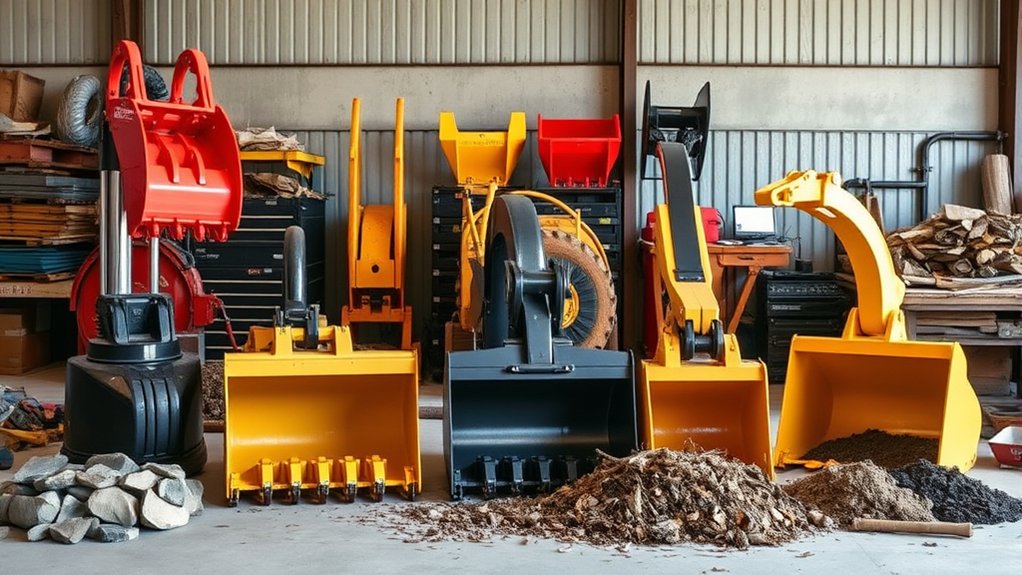
Selecting the right attachments is essential for tackling specific types of debris effectively. Different attachment types cater to varying debris characteristics, ensuring efficiency and precision in debris removal.
Choosing the appropriate attachments ensures efficient and precise debris removal by addressing specific debris characteristics.
For soft or vegetative debris, such as brush and foliage, consider grapple buckets for secure handling, mulching attachments for volume reduction, and broom attachments for light debris cleanup.
When dealing with hard or rigid debris like concrete, hydraulic rippers and hammer attachments become invaluable, breaking down tough surfaces.
Mixed and heavy debris, including scrap metal and large objects, benefit from hydraulic thumbs for stabilization and magnets for metal separation.
For organic and bulky debris, root rippers and hydraulic shears help manage logs and stumps, while soil and loose debris require digging buckets and trencher attachments for ideal handling.
To achieve seamless workflow efficiency in debris removal, integrating the right equipment is essential. Start by conducting thorough equipment compatibility assessments to guarantee that your machinery works in harmony.
Mobile grapple equipment, with its precision claw attachments, optimizes workflow by reducing manual labor and reaching obstructed areas. Pair these with heavy machinery coordination systems, like excavators and loaders, to create a closed-loop system for efficient debris relocation.
Implement workflow optimization strategies by aligning machinery operations with project phases, assuring each piece supports the next without bottlenecks. Additionally, integrate material handling systems like conveyors to streamline processes and minimize rehandling.
When selecting equipment for debris removal, you need to weigh the benefits of versatility against the necessity for operational efficiency.
Versatile equipment can adapt to various tasks, potentially reducing the need for multiple machines and lowering costs.
However, prioritizing equipment that enhances efficiency guarantees that your operations remain streamlined, ultimately saving time and resources in the long run.
There’s no denying that equipment versatility offers significant advantages when it comes to debris removal. By choosing versatile machines, you enhance both equipment durability and machine reliability, ensuring long-term performance across various tasks.
Consider these benefits:
These versatile options cater to diverse debris removal needs, balancing cost-effectiveness and performance seamlessly.
Maximizing operational efficiency in debris removal hinges on balancing cost-effectiveness with performance. You need to prioritize operational strategies that incorporate cost-effective technologies like route optimization software, reducing transportation costs by up to 10%.
Time-and-materials contracts provide flexibility, tailoring expenses to labor and equipment use. For equipment maintenance, confirm rental documentation aligns with FEMA funding compliance to avoid financial setbacks.
Integrating mobile monitoring systems allows real-time tracking, enhancing decision-making processes. While high-speed equipment like the Gator Getter delivers fast performance, safety in congested areas must be considered.
Automated systems such as ARDVAC improve efficiency but require adherence to safety protocols. By balancing these elements, you’ll enhance operational speed and maintain cost-effectiveness in your debris removal projects.
In your quest to select the right equipment for debris removal, remember that matching machinery to site conditions is essential. Did you know that using the right attachment can increase efficiency by up to 30%? Prioritize safety and operator visibility to guarantee smooth operations, and consider versatile machines for adaptability across various terrains. Balancing cost-effectiveness with performance guarantees you get the best return on investment, creating a more productive and efficient debris removal process.
Skip to content