
In Los Angeles, homeowners should call 811 at least two business days before any digging, then pre-mark the exact work footprint in white so utilities can be located accurately. They must understand which marks cover public lines versus private services on the property, and wait for markings before starting. Dig safely by staying well back from marked utilities, using hand tools within about two feet, and re-requesting locates if the job runs longer. If a gas line is hit, they should evacuate and call SoCalGas, then keep workers clear to learn more next.
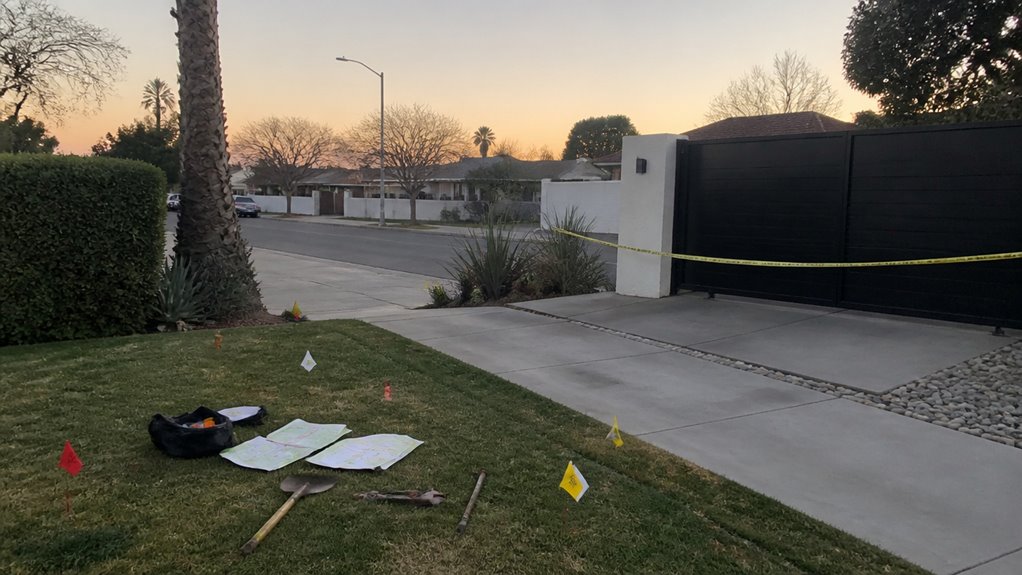
Calling 811 in Los Angeles should happen early, because California guidance requires the request be made at least 2 business days before digging starts, not just “two days” in the casual sense. Homeowners should also keep in mind that safety and environmental stewardship matter during the excavation phase, so timing the locate request early helps prevent delays and hazards. Homeowners should follow the 811 notification process, then plan the excavation timeline around working days, not calendar days. Calls submitted after normal business hours, especially after 6:00 p.m. on weekdays, may roll to the next business day. Since weekends are excluded, scheduling the call for Monday or Tuesday helps guarantee markings are completed in time. A locate request must be filed before any tools or equipment are used on site, so utilities can mark their lines before work begins. The requester typically provides location, dig type, and a start date.
Pre-marking the exact dig footprint in white should happen before utility locators arrive, because it visually defines the proposed excavation limits and prevents confusion on site.
California 811 guidance requires excavators to delineate or pre-mark the work area in white as part of excavation planning, not as a replacement for a 811 ticket.
Homeowners should use approved white marking materials such as white paint, chalk, flags, stakes, whiskers, or even flour if paint is unavailable, and choose temporary, clearly visible methods like white spray chalk or water-based UV paint on paved surfaces.
The marking shapes matter, since a single-point dig often uses a white circle, while trenches use solid or dashed white lines, typically 6–12 inches long, about 1–2 inches wide, spaced to match visibility needs.
Homeowners first check the public utility markers, since 811 normally labels utility-owned lines from the street or main supply up to the ownership or demarcation point, often near the meter or cleanout.
They then distinguish private service lines that usually begin after the meter or service point, including runs to the house interior-side systems and any owner-handled utilities like secondary water, sewer, and telecom.
Before digging, they also treat likely private irrigation, sprinkler control wiring, pool lines, and any detached-structure connections as candidates for private locating, because 811’s “clear” response does not mean every buried line on the property is found.
For contractors like Bobcat Contractor BSLA, this distinction matters so excavation and backfilling stay accurate, safe, and coordinated with the right utility boundaries.
Before anyone breaks ground in Los Angeles, the homeowner should learn how to read public utility markers so the dig stays safe and compliant.
After a free 811 locate request, white paint marks proposed excavation areas, while pink flags or paint show temporary survey work.
Marker color codes also reveal utility line types: blue indicates potable water, green signals sewer and drain infrastructure, and purple flags reclaimed water or irrigation slurry systems.
Red marks electrical power lines, and yellow marks gas, oil, steam, or other flammable materials.
Orange usually indicates communications, alarm, or signal lines.
Applicants should verify every responding operator, keep machinery at least 24 inches away, and switch to hand tools within two feet of marks.
If markings are unclear, re-comment through 811.
After the 811 locate is complete, the homeowner can still be caught off guard if they assume the markings cover everything underground on the lot. In Los Angeles, 811 usually marks public or utility-owned lines, not owner-owned service runs beyond the utility’s responsibility boundary. The dividing point is often the meter or another point of delivery, so piping from the meter to the home is frequently private, and may stay unmarked, which is critical for excavation safety and private line identification.
Sprinkler and pool areas often create the biggest “surprise factor” for excavation in Los Angeles, because 811 typically marks public utility lines rather than every buried feature on the property.
In the checklist, the homeowner should treat sprinkler systems as private irrigation lines, even when nearby utility paint or flags appear. Sprinkler zones, valve boxes, and buried control wiring may exist with no 811 markings, especially beyond the meter or in private landscaping areas.
Pool infrastructure also commonly involves private utilities, such as water supply, return lines, gas for heaters, electrical feeds, and bonding components.
After the 811 response, the homeowner should visually review the marked corridor, then arrange private locating if digging, trenching, or grading will reach irrigation or pool zones.
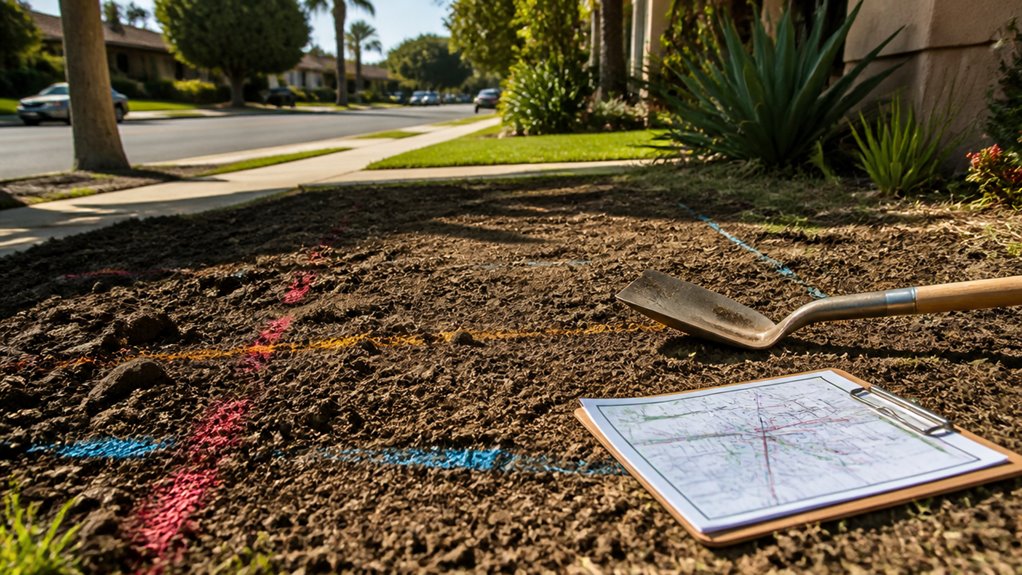
Start with a safety step that prevents costly damage and delays: wait for utility marks before any digging begins. Homeowners should contact 811 before digging, because California guidance requires waiting two full working days, excluding the request date, weekends, and holidays.
In Los Angeles County, DigAlert similarly directs callers to give at least two working days so utility crews can locate and mark underground lines. They should request notifications, white-mark the proposed area, and confirm the list of utilities matched by the marks.
Utility marking importance matters, since flags and paint show location, not exact depth. So excavation safety tips include treating marks as the controlling guide, documenting the layout, and requesting re-marks if coverage is incomplete.
To dig safely near utility marks, homeowners should switch to hand tools once the work edge reaches the marked tolerance zone, which is commonly about 18–24 inches on either side of the facility.
Mechanical excavation should stop within that zone, since guidance often extends the hand-dig requirement to 24 inches, depending on rules.
Hand digging is the standard method for utility exposure near marks, because it lowers the risk of punctures, cuts, and service interruptions.
Hand digging is standard near utility marks, reducing puncture and cut risks while helping prevent service interruptions.
Crews are typically instructed to excavate by hand until the exact utility location is confirmed, especially near pedestals, risers, meters, and similar structures.
Powered digging equipment stays outside the buffer, and excavation should proceed carefully and gradually to keep marks visible.
If needed, non-destructive options like vacuum excavation can help.
Because utility markings fade and expire, Los Angeles homeowners and contractors should re-request locates when a project runs beyond the original ticket window. Mark validity often lasts 10 to 30 days, so any plan to extend work should trigger a fresh locate before excavation timing runs into an expired marking set.
For long, multi-phase jobs, crews should treat locates as a series of windows, not one request that extend validity indefinitely. They should submit the next ticket when the team is three to five days from the next phase, and allow at least two to three full business days, or up to 10 working days for certain structured processes.

When an excavation crew or homeowner suspects it struck a gas line in Los Angeles, the plan should shift immediately from “keep work moving” to life-safety actions, since natural gas leaks can ignite quickly and travel beyond the cut area.
They should evacuate at once, keep people away, and treat this as part of emergency response. SoCalGas guidance says to call 911 immediately if natural gas is smelled, a leak is suspected, or damage is seen, and to notify the utility operator separately.
From a safe location, they should contact SoCalGas using either 1-800-427-2200 or (213) 244-8900, and report the exact location and type of damage, even a nick.
They should also shut off machinery, avoid switches, stop engines, and never try to cap the line.
To file an 811 ticket online in Los Angeles, the homeowner starts the online filing through USA North 811, 24/7.
They choose a new ticket, enter the correct street address or intersection, and select the work type.
They follow the ticket process by adding accurate locating instructions, optionally drawing the dig area as a polygon map.
They submit acknowledgments, then save the ticket number, and wait for utility markings before digging.
If the project area changes after utility marks arrive, the homeowner shouldn’t “wing it,” because that’s how confusion turns into risk.
Utility mark adjustments require a new locate when excavation boundaries, depth, or alignment shift, or if marks aren’t reasonably visible.
California 811 tickets are valid 28 calendar days, so revised work may need a refreshed request.
Excavation should stop in affected areas until fresh markings are completed.
Yes, he should call 811 even for small fence installation projects like backyard fence posts, because post holes are still excavation and can damage buried utilities.
The 811 process marks gas, electric, water, and communication lines, helping with digging safety. He should submit a locate request a few business days before digging, then wait for markings, and dig carefully, using hand tools near marked lines when possible.
Utility marks are generally valid for 28 calendar days from the ticket issue date, during which the work area can be excavated under the active ticket.
If marks stay reasonably visible, marks can be renewed without restarting, as part of the re request process.
If marks fade, disappear, or are disturbed, a re request is required immediately.
After the re request, utility members have 2 working days to respond, and excavation in that area must stop.
Who pays is oddly simple, yet the legal paperwork is not.
For sprinkler line responsibilities, damage liability usually follows the cause, not the location. If a contractor or homeowner’s hired crew physically hits a private sprinkler line, that party is often responsible, especially with negligence.
The property owner may pay first, then seek reimbursement from the responsible party or their insurance.
If the city work is involved, liability depends on whether public staff caused the damage.
Before you start digging in Los Angeles, remember the 811 process protects people and property, not just projects. Plan to call at least two business days early, pre-mark your dig area in white, and wait for utility crews to place accurate location marks before any tools hit the ground. A helpful detail, the 811 network routes requests to hundreds of participating utilities nationwide, helping reduce accidental line strikes. If marks fade, re-request before you continue.
Skip to content