
For large-scale earth moving projects, selecting the right equipment boosts efficiency. Crawler bulldozers handle heavy soil volumes while wheel loaders, equipped with robust buckets, make site mobility a breeze. Embrace precision digging with hydraulic excavators for stable operations. Use GPS with motor graders for accurate leveling and rely on draglines for deep excavations. Skid steer loaders excel in confined spaces, and drones offer real-time project monitoring. Discover how these techniques streamline your projects.

When tackling large-scale projects, choosing the right equipment is essential for ensuring efficiency and success. You need to evaluate the equipment’s durability to withstand challenging conditions and project scalability to adapt to various site demands.
Bulldozers, especially crawler models, are perfect for moving massive amounts of soil across rough terrain, making them indispensable for tasks like stadium leveling. For transporting heavy materials efficiently, wheel loaders come into play with their robust front-mounted buckets.
If your project exceeds 20 million cubic yards, like constructing an automotive manufacturing site, you’ll require high-output machines such as dragline excavators and wheel tractor-scrapers. These machines handle extreme volumes through continuous-cycle operations, ensuring that your project stays on schedule and within budget. Additionally, working with a top excavating contractor can provide access to advanced techniques and equipment tailored for large-scale excavation projects.
Selecting the right equipment is just the beginning; mastering the art of precision digging with hydraulic excavators takes your project to the next level.
To achieve this, focus on precision techniques and excavation strategies that enhance performance. Here’s a quick guide to improve your skills:
Additionally, understanding bobcat services can further enhance project outcomes by ensuring efficient site preparation and execution.
Maneuvering confined spaces with skid steer loaders demands a blend of skill, knowledge, and careful planning. You must focus on confined space safety while maximizing skid steer maneuverability.
These machines are designed with a compact footprint, making them perfect for narrow passageways. Always guarantee that ROPS and safety bars are engaged for added protection. Familiarize yourself with the controls and adhere to the three-point rule to prevent accidents.
Conduct daily inspections and never exceed the Rated Operating Capacity (ROC) limits. Navigate tight spaces using slow-speed operations and adjust bucket angles for precision. Proximity sensors and auxiliary supports enhance safety, while clean windshields and mirrors maintain visibility.

Using GPS laser systems in motor graders revolutionizes your approach to precision in road construction, ensuring that each pass is accurate and efficient.
You’ll find that these systems provide real-time feedback, allowing you to adjust blade angles and heights with precision, resulting in a consistently level surface.
When aiming for accuracy in leveling tasks, the integration of GPS and laser technology in motor graders offers significant advantages.
You’ll benefit from GPS advancements and laser integrations that improve precision grading by up to 300%. Real-time monitoring and automated controls guarantee you meet strict grading specifications with ease.
Here’s how this technology transforms large-scale projects:
With these benefits, your operations become more efficient and economically viable.
Building on the remarkable advancements in GPS and laser technology, achieving precision in road construction relies heavily on the adept use of motor graders.
You need to master blade adjustments and slope management for effective grading. Position the blade at a 60° angle relative to the center line to enhance material flow and precision cutting. Manage the heel-toe alignment to prevent material from flowing under the rear tires.
When handling slopes, start grading from the bottom to spot any soft spots, and articulate tandems on level ground. For rocky or wavy surfaces, use lower gears for controlled speed and precision.
Adjust the saddle left or right to improve reach on slopes, ensuring the creation of consistent road surfaces.
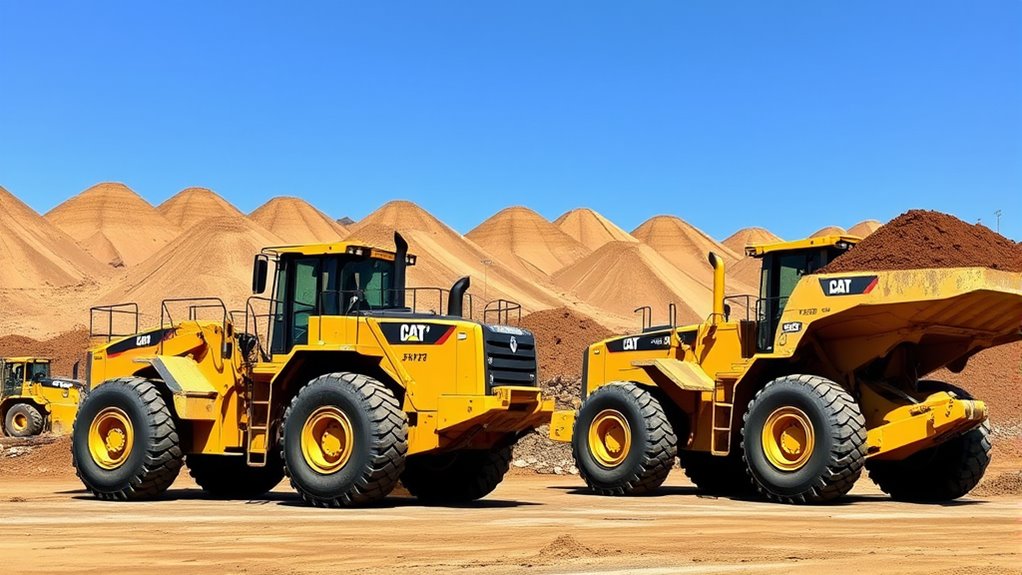
When it comes to enhancing site mobility, wheel loaders are your go-to option for efficient material transport, especially with their articulated joints and oscillating axles that guarantee smooth maneuverability on uneven terrains.
You’ll appreciate how the advanced hydraulic systems, featuring 156 HP engines and 180 l/min hydraulic pumps, optimize heavy material handling by allowing for rapid and precise movements.
With features like quick coupler systems and auxiliary hydraulic capabilities, these machines not only minimize downtime but also expand your operational versatility across various projects.
Efficient material transport is essential for enhancing site mobility, and wheel loaders are the workhorses that make it happen. They boost site accessibility and adapt to varying terrains, ensuring seamless operation.
Here’s how they enhance your project:
Maximize productivity by leveraging these features.
While wheel loaders are renowned for their strength and versatility, it’s their advanced hydraulic systems that truly elevate material transport efficiency to new heights.
You benefit from hydraulic efficiency through rapid cycle times and high load capacity, moving large volumes of soil or gravel swiftly. Fluid dynamics optimize hydraulic pressure, ensuring smooth lifting and dumping, minimizing wear and spillage.
These systems allow simultaneous tasks, like bucket movement and steering, boosting productivity. With real-time adjustments and pressure regulation, you maintain precise control, even on rocky terrain. This precision reduces operator fatigue and enhances load stability.
Additionally, energy efficiency is achieved by smart power distribution and mechanical-to-hydraulic conversion, cutting fuel costs and maximizing operational effectiveness in various environments.
Deep excavation techniques using draglines revolutionize large-scale mining operations with their remarkable efficiency and power.
You can enhance dragline operations and excavation efficiency by understanding these key points:
As drone technology continues to advance, it provides unparalleled capabilities for monitoring progress in large-scale earth-moving projects. With real-time monitoring, you can track progress using high-resolution aerial imaging, capturing daily, weekly, or monthly updates.
Real-time drone monitoring revolutionizes earth-moving projects with high-resolution imaging and frequent updates, ensuring precise progress tracking.
This technology allows you to create 3D models and point clouds through photogrammetry, offering detailed site analysis. Live feeds help identify issues early, preventing costly delays. By integrating with construction software, updates become instantaneous.
Drones can cover up to 700 acres in a single day, ensuring no detail is missed. For precision, drones eliminate truck-counting errors, using GCPs, RTK, or PPK technology for 3cm accuracy.
Automatic volume calculations and cut/fill maps provide clarity on material needs, offering centimeter-level accuracy to prevent disputes over material volumes.
In managing large-scale earth-moving projects, you’ll find that selecting the right equipment is essential to success. Just as a Swiss Army knife offers versatility, hydraulic excavators, skid steer loaders, and motor graders each play a unique role. Wheel loaders efficiently transport materials, while draglines tackle deep excavations. Drones offer a bird’s-eye view, ensuring precision and progress tracking. By mastering these techniques, you’re equipped to handle any challenge, ensuring your project is completed efficiently and accurately.
Skip to content