
When choosing the right equipment for trenching, start by evaluating your project’s needs, including space, soil, and terrain conditions. Evaluate equipment types like walk-behind trenchers, ride-on models, and directional drills based on their power and maneuverability. Brands like Ditch Witch and Vermeer offer innovative features for diverse applications. Safety measures, such as protective systems and regular maintenance, are essential. Discover how these factors, combined with the right tools, guarantee efficient and safe trenching operations.

When you’re starting a trenching project, evaluating the scope and requirements is fundamental to guarantee everything goes smoothly.
First, examine the available space to confirm machinery can maneuver efficiently without obstruction from trees or brush. Consider the proximity to high-traffic areas and pedestrian pathways, which might influence your project timelines.
Understanding the slope gradient is critical for predicting drainage challenges and maintaining equipment stability. Evaluating soil type and compaction levels is essential for guaranteeing trench stability and adhering to budget constraints.
Analyze safety and environmental factors, such as daily hazard evaluations and traffic control protocols, to maintain a safe work environment. Moreover, partnering with local expertise can provide valuable insights into navigating Los Angeles’ unique urban landscape.
Don’t forget to perform utility locating surveys to prevent conflicts and confirm your project stays within budget and on schedule.
A wide array of trenching equipment is available, each designed to meet specific project needs and challenges. Choosing the right tool involves understanding its capabilities and guaranteeing proper equipment maintenance and operator training. Here’s a quick comparison of different trenching options:
| Equipment Type | Capabilities |
|---|---|
| Handheld Trench Diggers | Small-scale digging, manual operation, portability |
| Walk-Behind Trenchers | Mid-range power, precision applications |
| Ride-On Trenchers | High-power engines, wider cuts |
| Horizontal Directional Drills | Thrust power, precision tracking |
When selecting trenching equipment, consider the project scale and terrain. Handheld trench diggers offer simplicity for minor tasks, while ride-on trenchers handle more extensive projects. Proper training guarantees safety and efficiency, while regular maintenance keeps your equipment reliable and ready for any job. Additionally, understanding the importance of excavation ensures that all trenching processes contribute to the overall success of your project.
Understanding the complexities of soil and terrain challenges is vital for successful trenching projects. Start by evaluating soil moisture, as it affects trench stability and equipment choice.
Use plasticity evaluation to classify soils by consistency. This involves manual manipulation and water content tests, helping identify cohesive soils that may require specialized handling.
Conduct cohesion testing using shear box or vane tests to assess bonding strength, essential for understanding soil stability.
Terrain mapping, through techniques like Cone Penetration Tests (CPT), offers detailed insights into subsurface layers, guiding equipment selection.
These assessments, including visual inspections and tactile analysis, guarantee you’re prepared for any soil or terrain challenges.
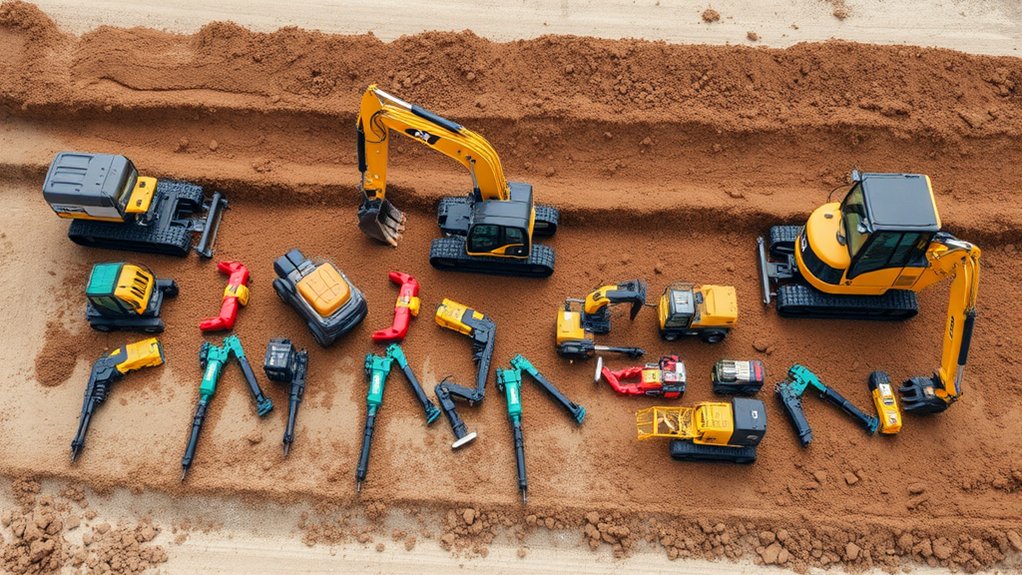
When selecting tools for precision and efficiency in trenching, consider trench depth, equipment maneuverability, and soil compatibility.
You’ll find that handheld trenchers offer great maneuverability for tight spaces, while ride-on models provide the depth needed for large-scale projects.
Additionally, matching the tool’s capabilities with soil conditions guarantees peak performance and reduces the risk of equipment damage.
Selecting the right tools for trenching requires careful consideration of trench depth to guarantee precision and efficiency.
Understanding trench safety is essential, especially with OSHA mandates for protective systems in trenches 5 feet or deeper, unless stable rock is present.
You’ll need to conduct a thorough soil analysis to determine the appropriate support method, such as using slopes, benches, or structural supports.
When trenches exceed 20 feet, professionally engineered solutions become necessary.
Soil type and groundwater presence influence stability, affecting your equipment choices.
Additionally, depth rating matrices from manufacturers and Registered Professional Engineers (RPEs) guide your equipment selection, ensuring compliance and safety.
While selecting trenching equipment, maneuverability factors play an essential role in achieving precision and efficiency.
You’ll need to take into account track selection, as it directly impacts equipment stability and the ability to handle various terrains. Wider tracks enhance stability on slopes and soft or uneven ground, while narrower tracks are ideal for rocky or hard soils, reducing undercarriage stress.
Rubber tracks are particularly useful for minimizing ground damage, especially on sensitive surfaces like turf or grass.
Compact pedestrian trenchers excel in tight urban spaces, offering precision with their ability to navigate confined areas.
Skid-steer trenchers, equipped with lockable switches, guarantee unassisted, linear digging.
Understanding maneuverability factors sets the stage for addressing soil compatibility challenges in trenching operations. Soil stability is essential when considering equipment selection, as different soil types demand specific solutions. In cohesive soils like Type A, trenchers work well unless instability issues arise. For submerged or saturated soils, slurry trenching or soil mixing helps manage groundwater and prevent collapse. Coarse soils with boulders necessitate pre-clearing, guaranteeing your trencher operates efficiently.
| Soil Type | Compatibility Issue | Recommended Equipment |
|---|---|---|
| Coarse soils with boulders | Obstructions can stall operations | Pre-clearing required |
| Cohesive (Type A) | Instability may persist | Alternative methods if needed |
| Submerged (Type C) | Risk of collapse | Slurry trenching or soil mixing |
| Intact rock | Traditional methods ineffective | Drilling or blasting |
| Layered soil systems | Varying stability zones | Hybrid systems |
Choosing the right tools guarantees precision and efficiency, addressing soil compatibility challenges effectively.
When you’re comparing power and maneuverability options for trenching equipment, it’s crucial to find the balance that suits your project needs.
Power efficiency and maneuverability balance are key considerations. For smaller tasks like installing sprinkler systems, walk-behind trenchers with 6–15 hp offer the right power without sacrificing control.
If you’re tackling projects with moderate soil resistance, mid-range options like the Vermeer RTX250, with 25–49 hp, provide efficient digging capabilities.
High-power units, 120+ hp, are built for challenging conditions, offering ergonomic features to reduce fatigue.
Consider using tracks for better traction on uneven terrain, while tires work well on hard surfaces.
Walk-behind models excel in precision, especially in tight spaces, though they move slower than ride-ons.
When selecting trenching equipment, you’ll find top brands like Ditch Witch, Vermeer, Toro, and Trencor leading the way with specialized models for various needs.
Ditch Witch offers both walk-behind and ride-on options, while Vermeer provides models known for their versatility in both pedestrian and heavy-duty applications.
Each brand presents unique features like integrated backfill blades and quad-track designs, ensuring you can match the right equipment to your project requirements with precision.
In the domain of trenching equipment, a few key brands stand out for their innovative and reliable models. Ditch Witch and Vermeer lead the industry with advancements in trenching technology, offering models that simplify trenching equipment maintenance. Ditch Witch’s RT45 and RT80 models are perfect for heavy-duty digging, while compact options like the C16X provide versatility for smaller projects. Vermeer’s RTX series, including the RTX250, offers flexibility with track/tire options for varied terrains.
| Model | Engine Power | Maximum Depth |
|---|---|---|
| Ditch Witch C24X | 24-hp | 36″ |
| Vermeer RTX200 | 20-hp | 36″ |
| Ditch Witch RT80 | 72-hp | 18ft |
Choose the right trencher based on your project’s demands, ensuring efficiency and reliability across different terrains.
Exploring the specialized features of trenching equipment reveals the innovation and precision that key brands like Virnig and Eaton bring to the table.
With specialized chain designs, Virnig’s anti-backflex chains and reversible chain rotation offer versatility for handling rough terrain and hard soil, ensuring efficiency and durability. Eaton’s high-torque motors optimize these chain systems, enhancing performance in demanding tasks.
Depth adjustment systems are another standout feature, with Virnig’s 4-position settings allowing consistent trenches in 6-inch increments and offering precise control to avoid underground utilities. The manual side-shift mechanism provides flexibility to trench near obstacles while maintaining precision.
These features make trenching projects more efficient, safe, and adaptable, ensuring you have the right equipment for various applications.
Although trenching projects offer significant opportunities for development, integrating the right safety measures and supplementary tools is crucial to guarantee the safety of all involved.
Begin by implementing strict safety protocols and confirming equipment maintenance is regularly performed. Protective systems like trench boxes and shoring provide necessary structural support, particularly in trenches five feet or deeper.
A competent person should inspect daily, adjusting safety measures based on soil type and site changes. For entry and exit safety, always use ladders, steps, or ramps in trenches over four feet deep, and verify access points are within 25 feet apart.
Use supplementary tools such as gas detectors to monitor air quality, and warning systems to prevent accidents, maintaining a safe and efficient work environment.
Choosing the right trenching equipment isn’t just about picking the biggest bulldozer in the yard; it’s about understanding your project’s needs like a pro. Consider the soil, terrain, and specific job requirements before you make any moves. Familiarize yourself with different equipment types and their capabilities, and don’t forget to factor in power, maneuverability, and safety features. With this knowledge, you’ll be ready to tackle your trenching project efficiently, like a seasoned time traveler tackling an ancient mystery.
Skip to content