
Soil compaction is essential in construction, enhancing stability and durability. It involves densifying soil, reducing voids, and increasing load capacity. Different soil types, like coarse-grained and fine-grained, compact differently. Testing, like the Proctor Test, helps identify best moisture levels and density. Effective compaction requires the right equipment, like smooth drum rollers and padfoot rollers, along with moisture control. These practices prevent issues like settlement and erosion, ensuring solid construction. Dive deeper for more insights.
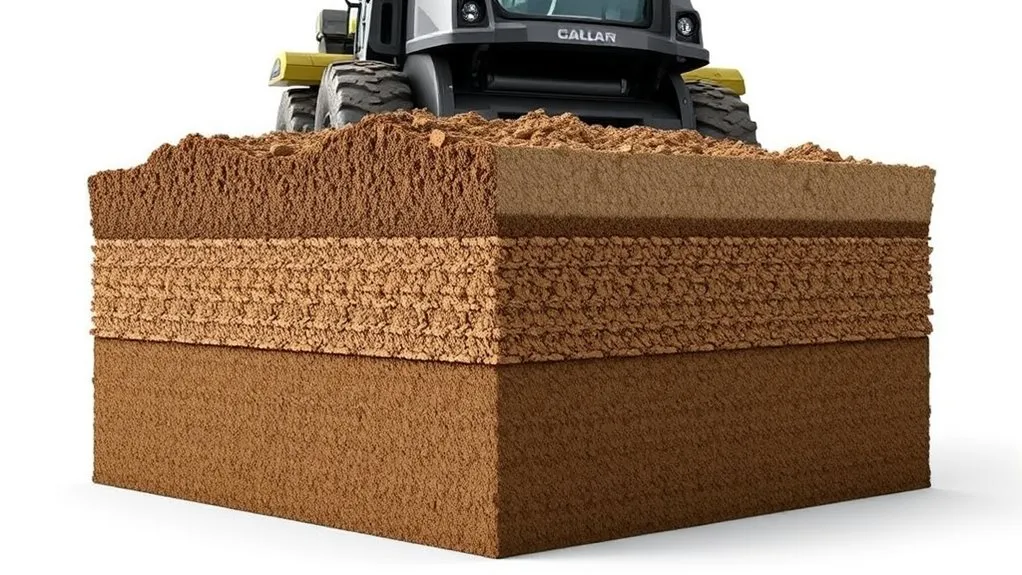
When it comes to construction projects, soil compaction is essential for guaranteeing stability and longevity. You need to focus on the core objectives of soil compaction, which revolve around several soil stabilization techniques.
By densifying surface layers, you reduce void spaces between soil particles, maximizing dry density and enhancing shear strength. These compaction benefits include increasing the bearing capacity and shear strength of the soil, making it more resistant to load and minimizing structural damage.
Compaction also prevents soil settlement, eliminating voids that might lead to subsidence and pavement failure. Additionally, compacted soils enhance stability and durability, resisting frost heave and erosion. Proper compacting techniques are crucial for ensuring that construction projects meet safety and reliability standards.
Understanding how different soil types behave during compaction is essential for the success of any construction project.
Compaction behavior of soil types is crucial for construction success.
Soil texture greatly influences compaction efficiency, as each type reacts uniquely under pressure. Coarse-grained soils like sand and gravel settle quickly but may struggle to interlock efficiently, affecting stability.
Fine-grained soils such as clay require careful moisture control to avoid issues during compaction. Well-graded soils, with their diverse particle sizes, compact efficiently, providing strong, stable grounds. Conversely, poorly graded soils resist compaction due to limited particle interlocking.
Consider these factors when evaluating soil for your project:
Recognize these distinctions to maximize your compaction results. Additionally, understanding specialized grading services can enhance leveling precision, ensuring the site is prepared adequately for construction.
To guarantee ideal soil compaction, understanding and applying the right testing methods and industry standards is essential.
Lab testing methods like the Standard Proctor Test and Modified Proctor Test are critical. These tests define best moisture content (BMC) and maximum dry density (MDD) through specific testing standards, such as ASTM D698 and D1557. They help establish baseline performance parameters and are fundamental for projects with heavy loads or chemically stabilized soils.
Field methods like the Nuclear Density Gauge and Sand Cone Test provide in-place density measurement, ensuring compliance with lab-derived MDD. Accurate density calculations are made by considering both mass and volume, adjusting for moisture.
These thorough techniques guide you toward achieving ideal compaction, essential for construction success.
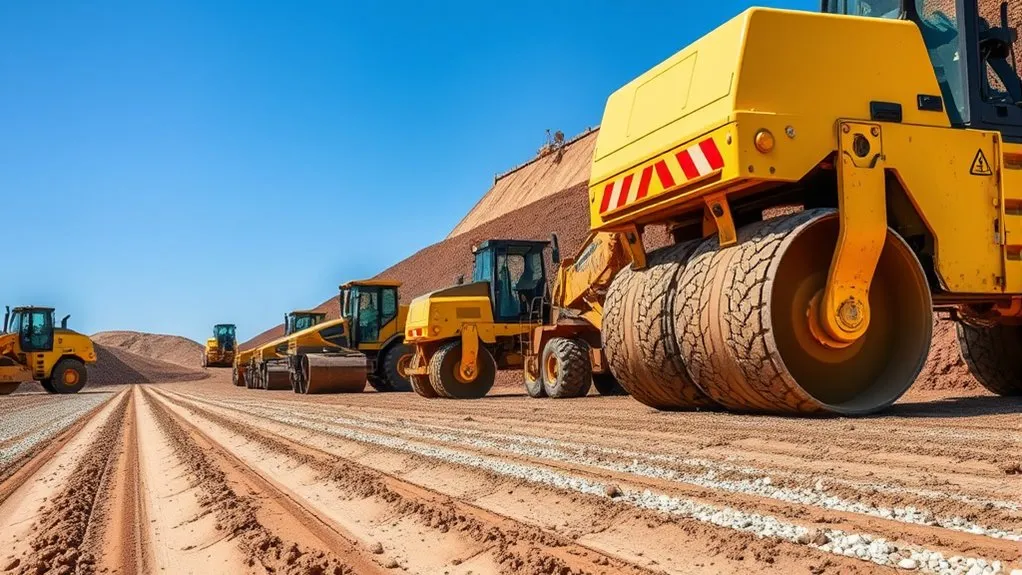
Achieving effective soil compaction requires the right equipment and techniques tailored to your project’s specific needs.
Equipment selection is essential: for cohesive soils in tight spots, you might choose rammer compactors, which deliver high-impact forces. For granular soils, plate vibratory compactors provide excellent results through combined weight and vibration. Smooth drum rollers are perfect for finishing layers, ensuring uniform surfaces in roadwork. Meanwhile, padfoot rollers excel with cohesive soils, breaking particle bonds without loosening the surface.
Key compaction methods include layer-by-layer compaction to prevent inadequate density and vibratory versus static force to penetrate deeper or finish surfaces.
Remember these essentials:
To achieve ideal moisture content (IMC), you need to strike the right balance between water and soil cohesion, which is vital for maximizing soil density and guaranteeing stable construction.
Field moisture adjustments are key, requiring careful monitoring and sometimes adding or removing water to reach the best level.
Understanding the balance between water and cohesion is vital for achieving ideal moisture content in soil compaction. You need to manage water retention carefully to enhance particle interaction.
When water acts as a lubricant, it reduces friction, allowing soil particles to move more freely, which is essential for effective compaction. Below the critical moisture threshold, particles are friction-bound, making compaction inefficient. Above this threshold, water begins to replace mechanical interlock with cohesion, which can hinder densification.
The goal is to reach the best moisture level where adhesion is maximized without creating hydraulic bonds. Achieving this balance guarantees:
When you’re working on soil compaction, achieving the right moisture content is essential, yet it can be a challenging task. Proper moisture retention guarantees effective compaction, while adjustment techniques help you reach the ideal level. Start by maintaining a 50% dry and 50% wet ratio. Use lime-based reagents for chemical drying if the soil’s too wet. Delay operations or use disking to manage moisture effectively. Different soils require tailored approaches; clay-rich soils need more moisture than sand or gravel. Utilize the following techniques for best results:
| Technique | Purpose | Soil Type |
|---|---|---|
| Chemical Drying | Reduce moisture content | Wet soils |
| Test Strips | Identify compaction passes | All soil types |
| Layered Compaction | Control density with thin lifts | Cohesive soils |
Adjustments guarantee that the soil’s compacted to its ideal state.
While tackling soil compaction challenges, it’s essential to recognize the unique characteristics each soil type presents. Understanding soil structure is vital because cohesive and non-cohesive soils demand different techniques.
You’ll find that compaction uniformity often hinges on these distinctions. For instance, clay requires precise moisture management, whereas granular soils are more forgiving.
Compaction efficiency is influenced by:
Addressing soil compaction challenges requires an understanding of how to avoid unintended compaction, which can compromise the stability of your construction project.
One key strategy is managing soil moisture. Avoid working the soil when it’s excessively wet, as this makes it more susceptible to compression. Instead, plan your construction timing to coincide with drier conditions or frozen ground periods, which naturally reduce compaction through freeze-thaw cycles.
Use lighter, smaller equipment to minimize pressure on the soil. Restrict heavy machinery to essential areas using barriers or designated paths.
Establish temporary pathways with planks to direct traffic flow and reduce soil disturbance. By implementing these strategies, you can mitigate the risk of unintended compaction and guarantee the integrity of your project.
For related project questions, connect this compaction overview with our grading and compaction equipment overview and expansive soil preparation guide when discussing the site’s material and testing requirements.
Browse more articles in Grading, Drainage & Soil.
You’ve seen that successful soil compaction combines careful consideration of soil types, testing techniques, and timing. Tackle terrain with the right tools and techniques to achieve great ground stability. Ensuring ideal moisture is essential, as it impacts the effectiveness of every effort. By addressing challenges and avoiding unintended issues, you’re ensuring enduring and efficient construction. Remember, the key to compaction success lies in the details—diligently directing each decision leads to a solid, sustainable foundation.
Skip to content